
Grades 1–3 (P.1–P.3)
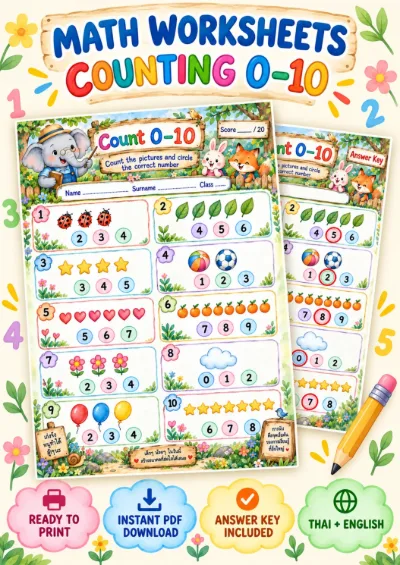
Count 0-10 - Count and Circle
19 Baht
View detailsMathematics
An AR classroom game for Grade 2. Learners can aim with their hands at the camera or play by tapping the screen.
This set has 4 rounds in an interactive sorting activity.
Curriculum indicatorค 2.2 ป.2/1
A look before you play
A few real prompts from the game to help you choose an activity for your class.
Sort into
Shapes with all sides equal, and shapes without.
Sort into
Numbers in the two times table are the even numbers.
Sort into
Compare with fifty, which is half of a hundred.
Before you play
Classify polygons by the length of their sides (indicator ค 2.2 ป.2/1), and sort numbers by a rule: in the 2 times table or not, above or below 50, and sums that make exactly 10.
4 sorting questions, drag items into two boxes - A square and an equilateral triangle go in "all sides equal" - 6 and 10 are in the 2 times table; 7 and 15 are not - 32 and 45 are less than half a hundred; 68 and 81 are more - 5 + 5 and 7 + 3 make exactly 10; 4 + 5 and 6 + 5 do not
Use as an end-of-lesson review, 6-8 minutes. In team mode, pupils take turns dragging one card each. - For the shapes question, have shape cards or a ruler ready so pupils can check the sides - For half a hundred, first ask "What is half of a hundred?" and settle on 50 before sorting - Afterwards, ask pupils to find classroom objects whose sides are all equal - Play it linked to the class to record results in the mark book
- Putting the rectangle in "all sides equal" because opposite sides match. Stress that every side must be the same length - Unsure about the right-angled triangle since there is no picture. Draw one on the board and explain that "sides not equal" means not all sides equal: a right-angled triangle can have two equal sides, but never all three - "Half a hundred" is unfamiliar wording; some compare with 100 instead of 50 and misplace 68
Grades 1–3 (P.1–P.3)
Grades 1–3 (P.1–P.3)
Grades 1–3 (P.1–P.3)
Grades 1–3 (P.1–P.3)
 Multiple choice
MathematicsGrade 16 questions
 Multiple choice
MathematicsGrade 16 questions
 Ordering
MathematicsGrade 14 rounds
 Sorting
MathematicsGrade 14 rounds