
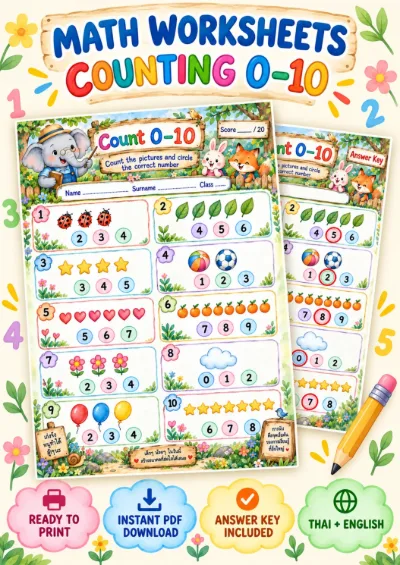
Grades 1–3 (P.1–P.3)
Count 0-10 - Count and Circle
19 Baht
View detailsMathematics
An AR classroom game for Grade 3. Learners can aim with their hands at the camera or play by tapping the screen.
This set has 4 rounds in an interactive sorting activity.
Curriculum indicatorค 1.1 ป.3/1
A look before you play
A few real prompts from the game to help you choose an activity for your class.
Sort into
Compare with five hundred, going mainly by the hundreds digit.
Sort into
A number that divides exactly by ten ends in zero.
Sort into
The wording of the problem tells you which operation to use.
Before you play
Sort three-digit numbers by comparing with 500 and by whether they divide exactly by 10 (indicators ค 1.1 ป.3/1 and ป.3/2), sort word-problem phrases into adding or subtracting, and tell 2D shapes from 3D solids.
4 sorting questions with 2 boxes each - 234 and 451 are less than 500; 689 and 902 are more - 250 and 600 divide exactly by 10; 347 and 185 do not - "How many more?" and "How many are left?" use subtraction; "How many altogether?" uses addition - Triangle and circle are 2D; cube and sphere are 3D
Use for review at the start of P3, about 6 minutes, team mode. - "How many more?" often confuses pupils. After revealing, give an example: an older sibling has 15 baht and a younger one 9; how many more does the older one have? Show it is subtraction - For 2D and 3D, hold up a paper circle next to a real ball - In English mode Q3 shows two identical "how many altogether?" cards; both go under addition. Play in Thai mode to avoid the confusion - Play it linked to the class to record results in the mark book
- Putting "How many more?" under addition because of the word "more". Draw two comparison bars and find the difference - Some compare 451 and 689 by the ones or tens first. Stress the hundreds decide - Swapping circle and sphere because the Thai names are similar. Compare real objects
Grades 1–3 (P.1–P.3)
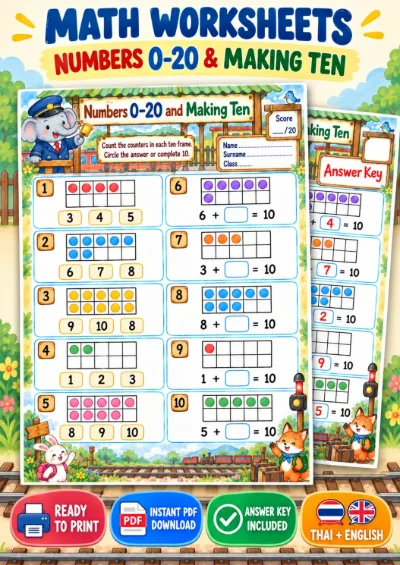
Grades 1–3 (P.1–P.3)
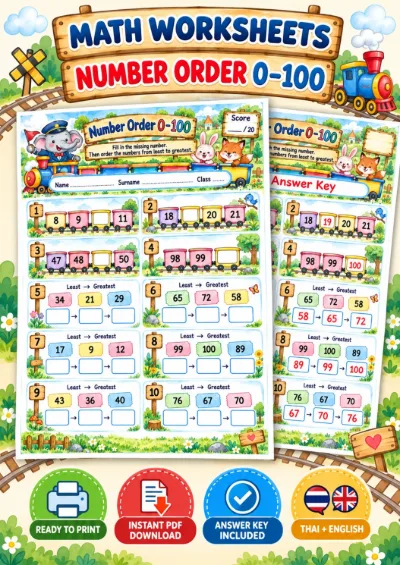
Grades 1–3 (P.1–P.3)
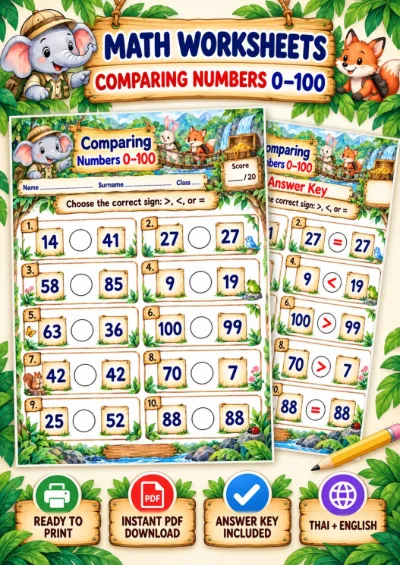
Grades 1–3 (P.1–P.3)
 Multiple choice
MathematicsGrade 16 questions
 Multiple choice
MathematicsGrade 16 questions
 Ordering
MathematicsGrade 14 rounds
 Sorting
MathematicsGrade 14 rounds