
Grades 1–3 (P.1–P.3)
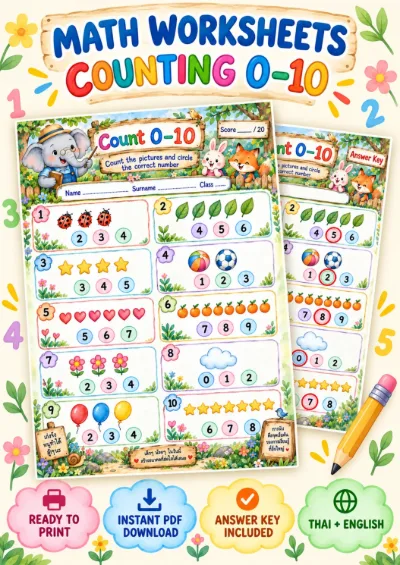
Count 0-10 - Count and Circle
19 Baht
View detailsMathematics
An AR classroom game for Grade 3. Learners can aim with their hands at the camera or play by tapping the screen.
This set has 4 rounds in an interactive matching activity.
Curriculum indicatorค 1.1 ป.3/6
A look before you play
A few real prompts from the game to help you choose an activity for your class.
The two to five times tables, to be known by heart.
The six to nine times tables, multiplied by seven.
Dividing asks what you multiply by to reach the starting number.
Before you play
Match products from multiplying by 8 and by 7 (indicator ค 1.1 ป.3/6), match divisions to their answers (ค 1.1 ป.3/7), and give the value of each digit in a three-digit number.
4 matching questions - 2 × 8 = 16 up to 5 × 8 = 40 - 6 × 7 = 42, 7 × 7 = 49, 8 × 7 = 56, 9 × 7 = 63 - 24 ÷ 3 = 8, 27 ÷ 9 = 3, 30 ÷ 5 = 6, 28 ÷ 7 = 4 - The 3 in 345 is worth 300; the 7 in 700 is worth 700
Use as a speed game at the end of a lesson, about 5 minutes, teams racing. - Multiplying by 7 is the hardest; in round one let teams write out the 7 times table, then play round two without it - For division, say the matching multiplication: 28 ÷ 7 means 7 × 4 = 28 - For place value, follow up: what is each 0 in 700 worth? - The Q1 on-screen explanation calls it the 2 to 5 tables, but the items multiply by 8 (2 × 8 to 5 × 8); show that 2 × 8 is the same as 8 × 2 - Play it linked to the class to record results in the mark book
- Swapping 7 × 7 = 49 and 8 × 7 = 56, which are only 7 apart. Recall 7 × 7, then add 7 - Matching 27 ÷ 9 with 8 because the numbers look close. Check by multiplying back - Matching the 4 in 345 to 4 instead of 40, reading the digit without its place
Grades 1–3 (P.1–P.3)
Grades 1–3 (P.1–P.3)
Grades 1–3 (P.1–P.3)
Grades 1–3 (P.1–P.3)
 Multiple choice
MathematicsGrade 16 questions
 Multiple choice
MathematicsGrade 16 questions
 Ordering
MathematicsGrade 14 rounds
 Sorting
MathematicsGrade 14 rounds