
Grades 1–3 (P.1–P.3)
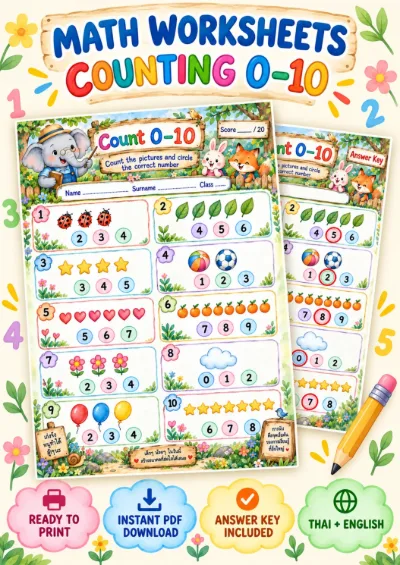
Count 0-10 - Count and Circle
19 Baht
View detailsMathematics
An AR classroom game for Grade 3. Learners can aim with their hands at the camera or play by tapping the screen.
This set has 4 rounds in an interactive ordering activity.
Curriculum indicatorค 1.2 ป.3/1
A look before you play
A few real prompts from the game to help you choose an activity for your class.
The six times table goes up in sixes: six times two to six times five gives twelve, eighteen, twenty-four, thirty.
Seven times two up to seven times five.
Compare the hundreds first, then the tens.
Before you play
Order products of the 6 and 7 tables as patterns growing in equal steps (indicator ค 1.2 ป.3/1), order three-digit numbers made of 0, 1 and 9 (ค 1.1 ป.3/2), and order the steps for solving a multiplication word problem.
4 ordering questions - 12, 18, 24, 30 going up in sixes - 14, 21, 28, 35 going up in sevens - 109, 190, 901, 910 smallest to largest - Read the problem, find how many groups, find how many in each group, multiply them together
Use before multiplication word problems, about 5 minutes, team mode. - 109, 190, 901, 910 is the richest item; have teams explain why 190 is less than 901 - After Q4, give a real problem such as "6 boxes with 7 in each" and have teams point to the number of groups - Play it linked to the class to record results in the mark book
- Swapping 190 and 901, or 109 and 190, since they use the same digits. Write them in a hundreds-tens-ones chart - Swapping "how many groups" and "how many in each group"; in practice either order works, but the game accepts only one; if a pupil swaps them and can explain, count the understanding as sound - Swapping 21 and 28 if the 7 times table is shaky
Grades 1–3 (P.1–P.3)
Grades 1–3 (P.1–P.3)
Grades 1–3 (P.1–P.3)
Grades 1–3 (P.1–P.3)
 Multiple choice
MathematicsGrade 16 questions
 Multiple choice
MathematicsGrade 16 questions
 Ordering
MathematicsGrade 14 rounds
 Sorting
MathematicsGrade 14 rounds