
Grades 4–6 (P.4–P.6)
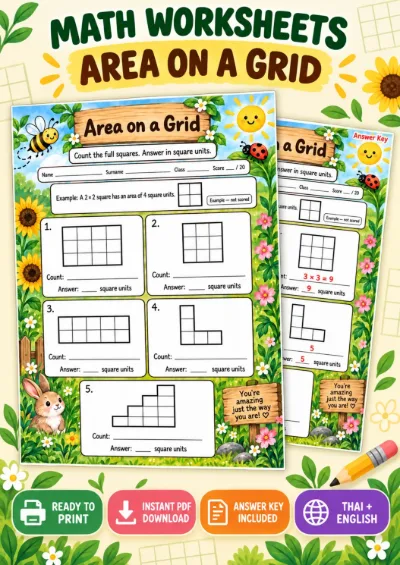
Area on a Grid - Count the Squares
19 Baht
View detailsMathematics
An AR classroom game for Grade 4. Learners can aim with their hands at the camera or play by tapping the screen.
This set has 4 rounds in an interactive sorting activity.
Curriculum indicatorค 1.1 ป.4/4
A look before you play
A few real prompts from the game to help you choose an activity for your class.
Sort into
Compare with a half: if the top is less than half the bottom, the fraction is less than a half.
Sort into
A prime number has exactly two factors.
Sort into
Separate the sequences that add from those that multiply.
Before you play
Compare fractions with a half (indicator ค 1.1 ป.4/4), sort primes from composites, tell patterns that add the same amount from those that multiply, and judge when an estimate is enough (indicator ค 1.1 ป.4/7).
4 sorting questions with 2 boxes each - 1/3 and 1/4 are less than a half; 2/3 and 5/8 are more - 17 and 23 are prime; 18 and 24 are composite - 3, 6, 9, 12 adds the same each time; 2, 6, 18, 54 multiplies - "Roughly how many kilometres did the car travel?" can be estimated; "How much change?" needs an exact answer
Use for P4 mid-term review, 6-8 minutes, team mode. - 3, 6, 12, 24 is a good trap: it starts 3, 6 like the adding pattern, so teams must check every step, not just the first two - After the estimation question, ask each team for one more situation where an estimate is fine - For primes, have teams list the factors of 23 on paper before deciding - Play it linked to the class to record results in the mark book
- Putting 3, 6, 12, 24 under adding by looking only at 3 to 6. Check every step: 6 to 12 is not +3 - Putting 5/8 under less than a half, not knowing half of 8 is 4 - Calling 23 composite because it is an unfamiliar odd number. Try dividing by 2, 3 and 5 - Thinking "What is the total price?" can be estimated, which is true when planning; discuss that paying needs the exact amount
Grades 4–6 (P.4–P.6)
Grades 4–6 (P.4–P.6)
Grades 4–6 (P.4–P.6)
 Multiple choice
MathematicsGrade 16 questions
 Multiple choice
MathematicsGrade 16 questions
 Ordering
MathematicsGrade 14 rounds
 Sorting
MathematicsGrade 14 rounds