
Grades 4–6 (P.4–P.6)
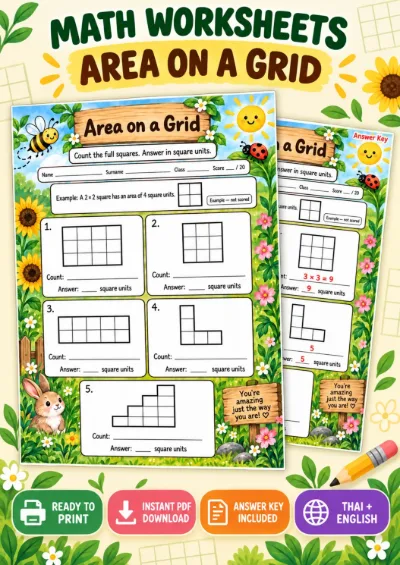
Area on a Grid - Count the Squares
19 Baht
View detailsMathematics
An AR classroom game for Grade 4. Learners can aim with their hands at the camera or play by tapping the screen.
This set has 4 rounds in an interactive sorting activity.
Curriculum indicatorค 1.1 ป.4/6
A look before you play
A few real prompts from the game to help you choose an activity for your class.
Sort into
A prime has two factors; a composite number has more.
Sort into
Shapes with right angles at every corner, and shapes with none.
Sort into
Compare with a half, which is nought point five.
Before you play
Sort prime from composite numbers, shapes with all right angles from those with none (indicator ค 2.2 ป.4/1), decimals above or below 0.5 (ค 1.1 ป.4/6), and units of time from units of length.
4 sorting questions with 2 boxes each - 2 and 13 are prime; 4 and 20 are composite - Square and rectangle have right angles all round; equilateral triangle and rhombus have none - 0.2 and 0.4 are less than 0.5; 0.8 and 0.9 are more - Hour and minute are units of time; metre and kilometre are units of length
Use for mid-year P4 review, 5-6 minutes, team mode. - 2 is prime; mention that it is the only even prime - For shapes, have teams draw a slanted rhombus and test its corners with a paper right angle - For decimals, use a 0 to 1 number line in tenths - Play it linked to the class to record results in the mark book
- Putting 2 under composite because it is even. Its only factors are 1 and 2 - Pupils picturing an upright, square-like rhombus put it under right angles. Draw a slanted one. If a pupil points out that a square is also a rhombus, they are right; the game means a rhombus that is not a square - Putting 0.4 above 0.5. Point to both on a number line
Grades 4–6 (P.4–P.6)
Grades 4–6 (P.4–P.6)
Grades 4–6 (P.4–P.6)
 Multiple choice
MathematicsGrade 16 questions
 Multiple choice
MathematicsGrade 16 questions
 Ordering
MathematicsGrade 14 rounds
 Sorting
MathematicsGrade 14 rounds