
Grades 4–6 (P.4–P.6)
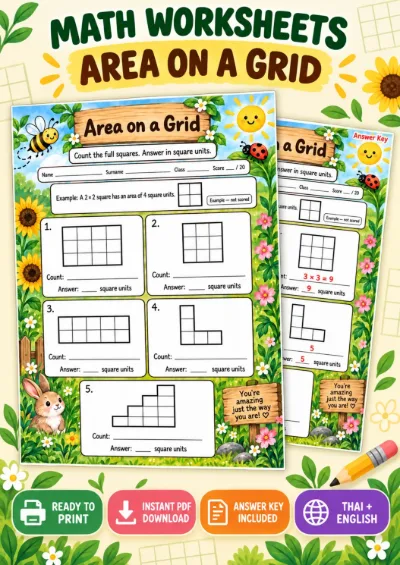
Area on a Grid - Count the Squares
19 Baht
View detailsMathematics
An AR classroom game for Grade 5. Learners can aim with their hands at the camera or play by tapping the screen.
This set has 6 questions in an interactive multiple choice activity.
Curriculum indicatorค 1.1 ป.5/3
A look before you play
A few real prompts from the game to help you choose an activity for your class.
One decimal place is tenths; five tenths simplifies to one half.
Two decimal places are hundredths; twenty-five hundredths simplifies to one quarter.
Line the decimal points up before adding: two tenths plus five tenths is seven tenths.
Before you play
Link one- and two-place decimals to fractions (0.5 = 1/2, 0.25 = 1/4, 0.7 = 7/10), compare decimals, and add and subtract one-place decimals, building on ค 1.1 ป.5/1.
6 questions, multiple choice with 3 options - Which fraction equals 0.25 (1/4) - 1.2 + 0.5 (1.7) - Which is largest: 0.9, 0.15 or 0.5 (0.9) - 3.4 - 1.2 (2.2) - 0.7 as a fraction (7/10)
Use after teaching decimal place value, as an understanding check; about 5-6 minutes. - Play solo, then look at the most-missed question on the summary screen - If many miss Q4, rewrite the options as 0.90, 0.15 and 0.50 and compare again - For Q3, have children write the sum in columns with the decimal points lined up - Play it linked to the class to record results in the mark book.
- Q4: children often pick 0.15 because 15 looks bigger than 9; pad with a zero so both have two places - Q3: 1.25 comes from writing the digits side by side without lining up the points - Q6: 7/10 confused with 7/100; count the places after the point - Q1: 1/5 may be chosen because the 5 is visible
Grades 4–6 (P.4–P.6)
Grades 4–6 (P.4–P.6)
Grades 4–6 (P.4–P.6)
 Multiple choice
MathematicsGrade 16 questions
 Multiple choice
MathematicsGrade 16 questions
 Ordering
MathematicsGrade 14 rounds
 Sorting
MathematicsGrade 14 rounds