
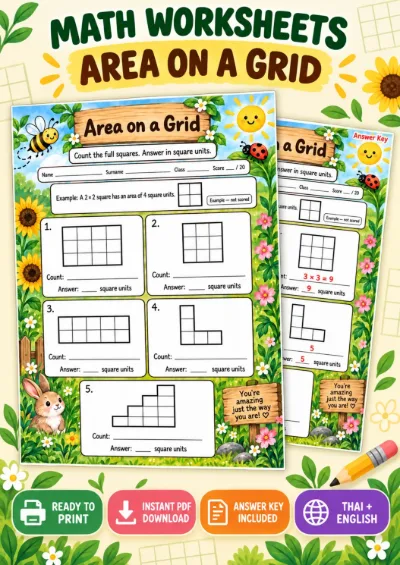
Grades 4–6 (P.4–P.6)
Area on a Grid - Count the Squares
19 Baht
View detailsMathematics
An AR classroom game for Grade 6. Learners can aim with their hands at the camera or play by tapping the screen.
This set has 6 questions in an interactive multiple choice activity.
Curriculum indicatorค 2.1 ป.6/3
A look before you play
A few real prompts from the game to help you choose an activity for your class.
Distance is speed times time: eighty times two is one hundred and sixty.
Speed is distance divided by time: a hundred and fifty divided by three is fifty.
Time is distance divided by speed: sixty divided by twenty is three hours.
Before you play
Use distance = speed × time to find distance, speed and time, including a case where minutes must be converted to hours first.
6 questions, multiple choice with 3 options - 80 km/h for 2 hours: distance (160) - 150 km in 3 hours: speed (50) - 60 km at 20 km/h: time (3) - 120 km in 90 minutes: speed per hour (80) - Which is the formula for distance (speed × time)
Use after teaching the distance-speed-time relationship; about 5-6 minutes. - Play as a class on the projector with a distance-speed-time triangle on the board; children cover the one they want - If many miss Q5, ask how many hours 90 minutes is, then reason that half an hour covers 40 km - Use Q4 to discuss that 5 km/h is a normal walking speed - Some items extend beyond primary indicators. Use them for discussion or preparation for Grade 7, not to judge attainment - Play it linked to the class to record results in the mark book.
- Q5: treating 90 as hours, or getting a non-whole 120 ÷ 90 and guessing 60 or 100 - Q3: multiplying 60 × 20 instead of dividing, then guessing 2 or 4 - Q6: unsure what divides what, choosing speed ÷ time - Q2: 45 or 55 from a division slip
Grades 4–6 (P.4–P.6)
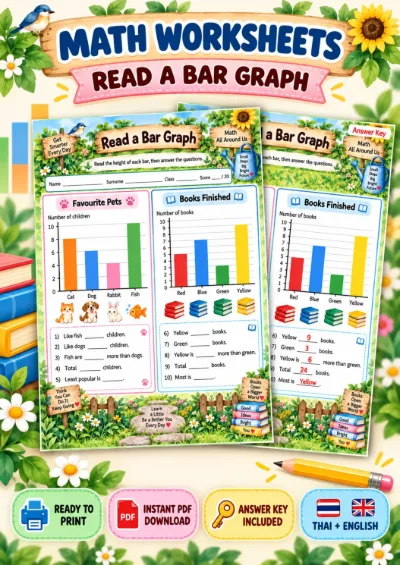
Grades 4–6 (P.4–P.6)
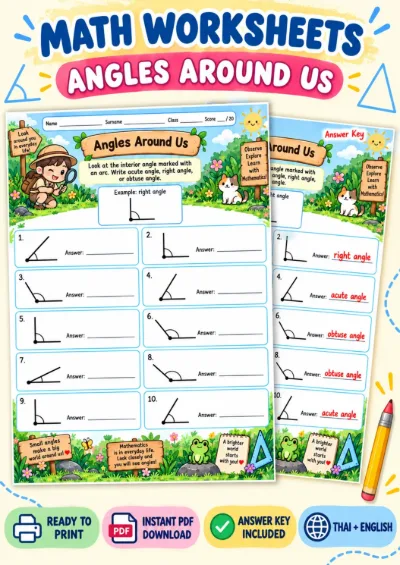
Grades 4–6 (P.4–P.6)
 Multiple choice
MathematicsGrade 16 questions
 Multiple choice
MathematicsGrade 16 questions
 Ordering
MathematicsGrade 14 rounds
 Sorting
MathematicsGrade 14 rounds