
Grades 1–3 (P.1–P.3)
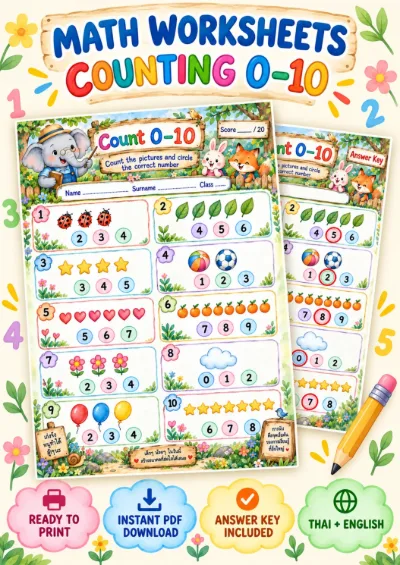
Count 0-10 - Count and Circle
19 Baht
View detailsMathematics
An AR classroom game for Grade 1. Learners can aim with their hands at the camera or play by tapping the screen.
This set has 4 rounds in an interactive sorting activity.
Curriculum indicatorค 2.1 ป.1/1
A look before you play
A few real prompts from the game to help you choose an activity for your class.
Sort into
Compare the real lengths of things around you.
Sort into
Compare weights by imagining lifting them.
Sort into
Compare the overall size of the things.
Before you play
Compare everyday things as long or short, heavy or light, big or small, holding more or less, without units, as groundwork for measuring length in centimetres and metres under ค 2.1 ป.1/1.
4 rounds, a sorting game with 4 items each - A ruler and a skipping rope are long; an eraser and a paper clip are short - A table and a school bag are heavy; a feather and a sheet of paper are light - A car and a house are big; an ant and a coin are small - A bucket and a big pot hold a lot; a spoon and a small glass hold little
Use to open the measurement unit, before children measure with a ruler. 5-6 minutes. - Play as a class, then compare the real items from rounds 1 and 2 by hand - For round 4, pour small glasses of water into a bucket to see how many it takes - If many miss round 2, ask "If you had to lift this, would it take a lot of effort?" - Play it linked to a class and the scores go into the class gradebook.
- In round 2, putting the school bag under light because an empty bag is light; say it means a bag full of books - In round 1, putting the ruler under short because it is much shorter than the rope; compare it with the eraser and clip - In round 4, mixing up holds a lot with big, as capacity is a new word
Grades 1–3 (P.1–P.3)
Grades 1–3 (P.1–P.3)
Grades 1–3 (P.1–P.3)
Grades 1–3 (P.1–P.3)
 Multiple choice
MathematicsGrade 16 questions
 Multiple choice
MathematicsGrade 16 questions
 Ordering
MathematicsGrade 14 rounds
 Sorting
MathematicsGrade 14 rounds