
Grades 1–3 (P.1–P.3)
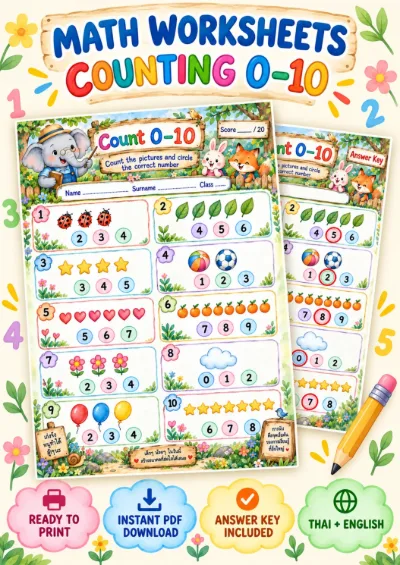
Count 0-10 - Count and Circle
19 Baht
View detailsMathematics
An AR classroom game for Grade 2. Learners can aim with their hands at the camera or play by tapping the screen.
This set has 4 rounds in an interactive ordering activity.
Curriculum indicatorค 1.2 ป.3/1
A look before you play
A few real prompts from the game to help you choose an activity for your class.
The three times table from three to twelve.
The four times table from four to sixteen.
Count back in tens from fifty.
Before you play
Order numbers going up in threes and fours (the 3 and 4 tables) and down in tens, groundwork for equal-step patterns (indicator ค 1.2 ป.3/1), and put the steps of two-digit column addition with carrying in order.
4 ordering questions - 3, 6, 9, 12 going up in threes - 4, 8, 12, 16 going up in fours - 50, 40, 30, 20 going down in tens - Line up the columns, add the ones, carry if you need to, add the tens
Use after the 3 and 4 tables and carrying, about 5 minutes, team mode. - After the addition steps question, have teams do 27 + 48 on paper following the steps they just ordered - 12 appears in both the 3 and 4 patterns; ask pupils why - Play it linked to the class to record results in the mark book
- In the addition steps, putting "add the tens" before "add the ones" because we read numbers left to right. Show with 27 + 48 that a carry changes the tens answer - Putting "carry if you need to" first, since pupils remember carrying as the hard part - Ordering 50, 40, 30, 20 smallest first out of habit
Grades 1–3 (P.1–P.3)
Grades 1–3 (P.1–P.3)
Grades 1–3 (P.1–P.3)
Grades 1–3 (P.1–P.3)
 Multiple choice
MathematicsGrade 16 questions
 Multiple choice
MathematicsGrade 16 questions
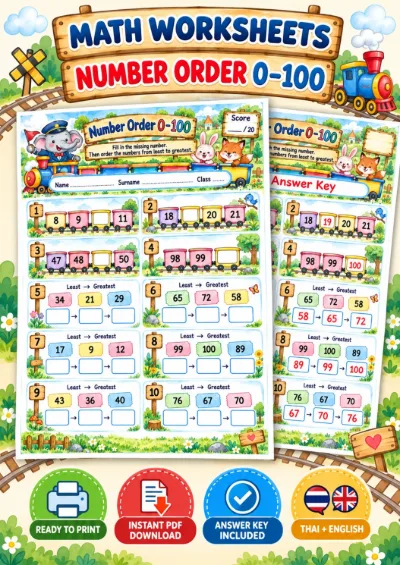
 Ordering
MathematicsGrade 14 rounds
 Sorting
MathematicsGrade 14 rounds