
Grades 1–3 (P.1–P.3)
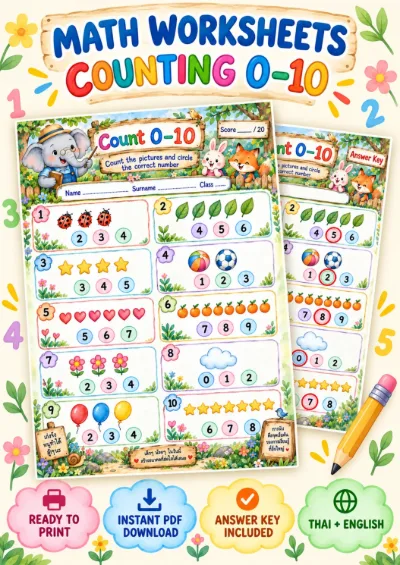
Count 0-10 - Count and Circle
19 Baht
View detailsMathematics
An AR classroom game for Grade 2. Learners can aim with their hands at the camera or play by tapping the screen.
This set has 4 rounds in an interactive sorting activity.
Curriculum indicatorค 1.1 ป.2/1
A look before you play
A few real prompts from the game to help you choose an activity for your class.
Sort into
A two-digit number has two figures; a three-digit number has three.
Sort into
Look at the sign in the problem - is it plus or minus?
Sort into
A number that divides exactly by ten ends in zero.
Before you play
Sort by different properties: two-digit versus three-digit numbers (indicator ค 1.1 ป.2/1), word-problem phrases that signal adding or subtracting, numbers ending in 0, and units of length versus weight, so pupils learn to name the rule before deciding.
4 sorting questions with 2 boxes each - 45 and 88 have two digits; 120 and 305 have three - "How many altogether?" signals adding; "How many are left?" and "How much is left after spending?" signal subtracting - 40 and 90 end in 0; 37 and 62 do not - Centimetre and metre measure length; gram and kilogram measure weight
Use before starting word problems, since Q2 practises reading key phrases. About 5-6 minutes, team mode. - After Q2, have teams write a short problem using "left" or "altogether" for another team to classify - For units, ask for an example object measured with each one - The Q2 on-screen explanation says to look at the sign, but the cards have no signs; tell pupils the key words (altogether, left) are the cue - In English mode Q2 shows two identical "how many altogether?" cards; both belong in "needs adding". Play in Thai mode to avoid the confusion - Play it linked to the class to record results in the mark book
- In Q2, weaker readers guess from card length. Have the cards read aloud one by one - "How much is left after spending?" mentions money, so some think of totalling. Underline "left" - Putting 305 in two digits because of the middle zero. Count the digits one by one - Grams may be unfamiliar; show a snack packet with its weight in grams
Grades 1–3 (P.1–P.3)
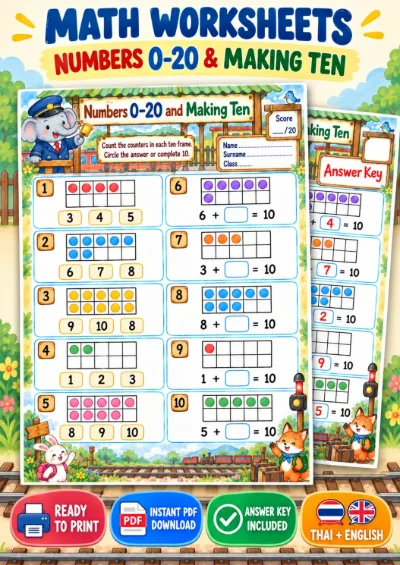
Grades 1–3 (P.1–P.3)
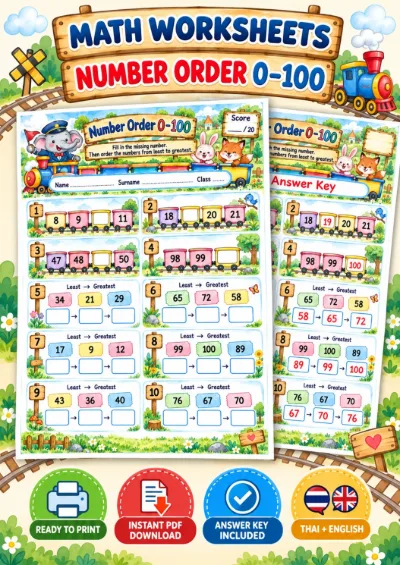
Grades 1–3 (P.1–P.3)
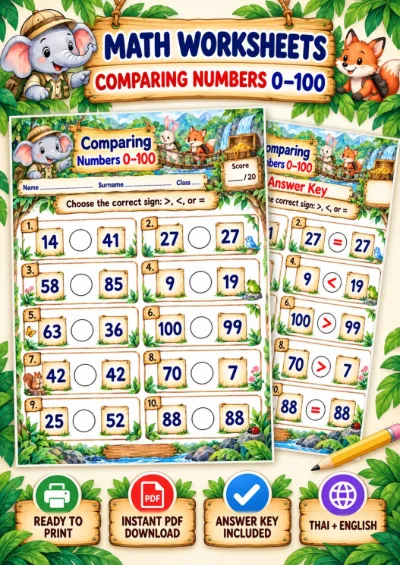
Grades 1–3 (P.1–P.3)
 Multiple choice
MathematicsGrade 16 questions
 Multiple choice
MathematicsGrade 16 questions
 Ordering
MathematicsGrade 14 rounds
 Sorting
MathematicsGrade 14 rounds