
Grades 4–6 (P.4–P.6)
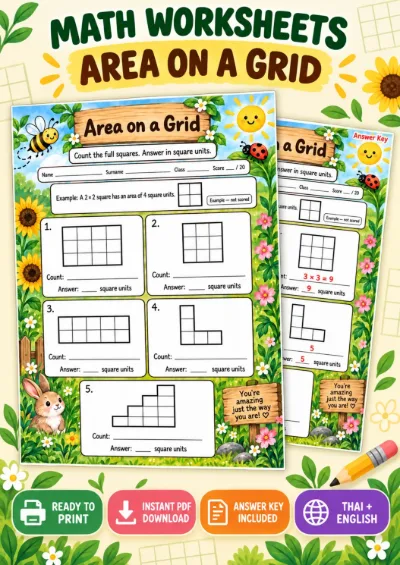
Area on a Grid - Count the Squares
19 Baht
View detailsMathematics
An AR classroom game for Grade 4. Learners can aim with their hands at the camera or play by tapping the screen.
This set has 6 questions in an interactive multiple choice activity.
Curriculum indicatorค 1.1 ป.4/4
A look before you play
A few real prompts from the game to help you choose an activity for your class.
Six times five is thirty - write zero, carry three; three times five is fifteen plus three, which is eighteen.
Four times thirty-two makes one hundred and twenty-eight.
The bottoms match, so add the tops: three fifths.
Before you play
Mixed P4 review: multiplication and long division (indicator ค 1.1 ป.4/9), adding fractions with equal denominators, rounding to the nearest hundred (ป.4/7), the area of a square, and subtracting decimals.
6 multiple-choice questions - 36 × 5 = 180 and 128 ÷ 4 = 32 - 2/5 + 1/5 = 3/5; distractor 3/10 - 384 rounded to the nearest hundred is 400 - A square with side 12 has area 144 - 3.6 - 1.4 = 2.2
Use as an end-of-term quick check, 8-10 minutes, solo mode with scrap paper allowed. - If many choose 3/10 for 2/5 + 1/5, draw a strip in 5 parts and shade 2 then 1 - For the square with side 12, the distractor 48 is the perimeter; use it to discuss area versus perimeter - Play it linked to the class to record results in the mark book, then use the per-question view to choose review topics
- Choosing 3/10 for 2/5 + 1/5 by adding the denominators too. Use fraction strips - Choosing 48 for the square with side 12 by working out the perimeter (12 × 4) instead of the area (12 × 12) - Choosing 380 for 384 by rounding to the nearest ten instead of hundred. Underline "hundred"
Grades 4–6 (P.4–P.6)
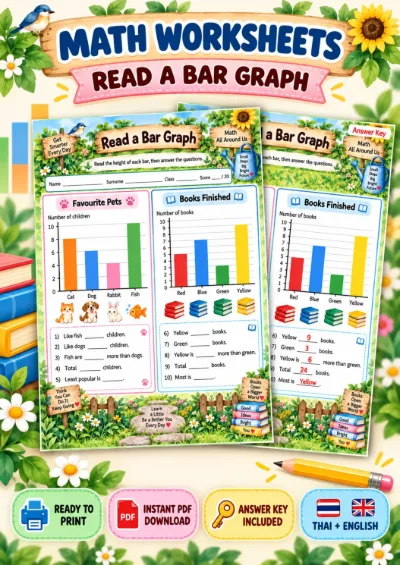
Grades 4–6 (P.4–P.6)
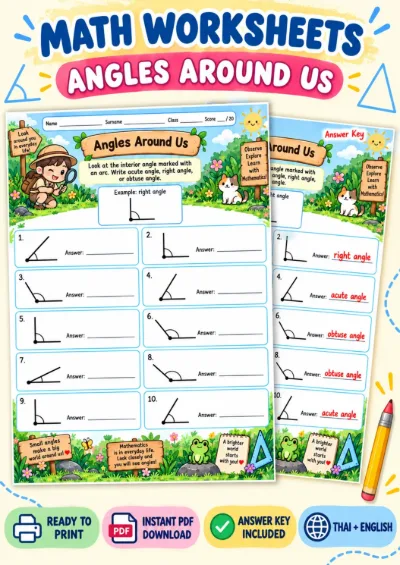
Grades 4–6 (P.4–P.6)
 Multiple choice
MathematicsGrade 16 questions
 Multiple choice
MathematicsGrade 16 questions
 Ordering
MathematicsGrade 14 rounds
 Sorting
MathematicsGrade 14 rounds