
Grades 4–6 (P.4–P.6)
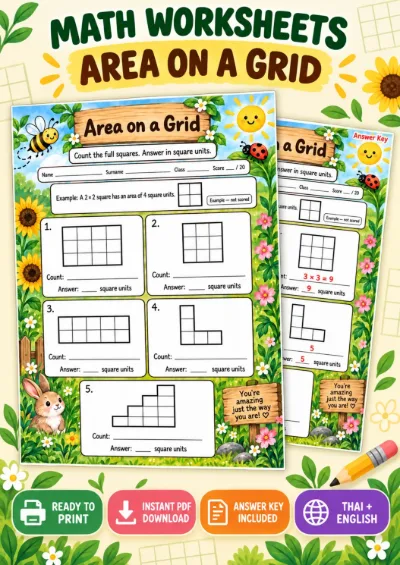
Area on a Grid - Count the Squares
19 Baht
View detailsMathematics
An AR classroom game for Grade 5. Learners can aim with their hands at the camera or play by tapping the screen.
This set has 4 rounds in an interactive sorting activity.
Curriculum indicatorค 2.1 ป.5/2
A look before you play
A few real prompts from the game to help you choose an activity for your class.
Sort into
Shapes with a curved edge, and shapes with only straight ones.
Sort into
A number divides by six exactly only if it divides by both two and three.
Sort into
Area formulas and perimeter formulas give answers in different units.
Before you play
Sort several kinds of maths knowledge: straight-sided versus curved shapes, numbers that divide exactly by 6, area versus perimeter formulas for rectangles and squares, and mixed numbers below or above 2.
4 sorting rounds, dragging 4 cards into 2 groups - Straight edges only or a curved edge: pentagon, circle, hexagon, oval - Divides exactly by 6 or not: 12, 14, 30, 20 - Finds area or perimeter: width × length, (width + length) × 2, side × side, side × 4 - Less or more than 2: 1 1/2, 2 1/4, 1 3/4, 3 1/2
Use as a review before the perimeter and area unit or as a lesson closer; about 4-5 minutes. - Solo mode works since each round is short, but let pairs talk before round 3 - If round 2 goes badly, explain that 6 = 2 × 3, so the number must be even and divide by 3, then test 14 and 20 - For round 3, have children draw a rectangle, shade the inside (area) and trace the edge (perimeter) - Play it linked to the class to record results in the mark book.
- Round 2: 14 or 20 may go in the divides-by-6 group because they are even; point out they must also divide by 3 (1 + 4 = 5, 2 + 0 = 2) - Round 3: side × side and side × 4 get confused because both say side; ask whether the side is multiplied by itself or four sides are added - Round 4: 1 3/4 may be put above 2 because of the 3 and 4; look at the whole number first
Grades 4–6 (P.4–P.6)
Grades 4–6 (P.4–P.6)
Grades 4–6 (P.4–P.6)
 Multiple choice
MathematicsGrade 16 questions
 Multiple choice
MathematicsGrade 16 questions
 Ordering
MathematicsGrade 14 rounds
 Sorting
MathematicsGrade 14 rounds