
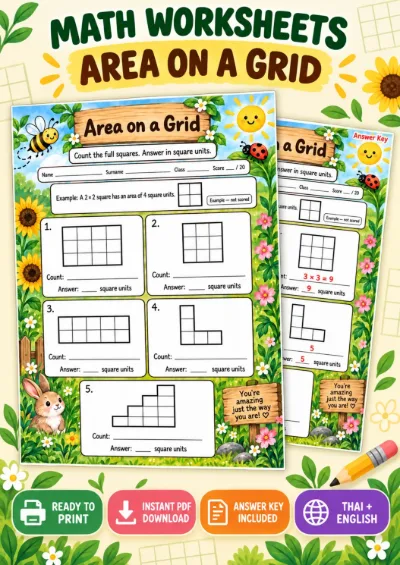
Grades 4–6 (P.4–P.6)
Area on a Grid - Count the Squares
19 Baht
View detailsMathematics
An AR classroom game for Grade 6. Learners can aim with their hands at the camera or play by tapping the screen.
This set has 4 rounds in an interactive sorting activity.
Curriculum indicatorค 1.1 ป.6/2
A look before you play
A few real prompts from the game to help you choose an activity for your class.
Sort into
A prime number has only two factors: one and itself.
Sort into
Area is measured in square units; volume in cubic units.
Sort into
A rational number can be written as a fraction of whole numbers.
Before you play
Sort several big ideas: prime versus composite numbers, area versus volume formulas, non-integers versus integers, and events that are likely or unlikely.
4 sorting rounds, dragging 4 cards into 2 groups - Prime or composite: 13, 21, 17, 25 - Area or volume formula: width × length, width × length × height, base × height ÷ 2, side × side × side - Can be written as a fraction or already a whole number: 0.5, 7, 0.25, -3 - Likely or unlikely: heads or tails on a coin, three 6s in a row, daylight tomorrow, winning first prize
Use as a cumulative review before a test; about 5 minutes. - Play in teams and pause after round 3, since the group names can spark debate - In round 2, count how many lengths are multiplied: two is area, three is volume - In round 4, discuss which events are certain and which are almost impossible - Play it linked to the class to record results in the mark book.
- Round 1: 21 and 25 may be put with the primes for being odd; check 3 × 7 and 5 × 5 - Round 3: children who know 7 = 7/1 will hesitate, since whole numbers can also be written as fractions - Round 3: -3 may confuse children who have not met negative numbers - Round 2: base × height ÷ 2 may go with volume because it has three symbols
Grades 4–6 (P.4–P.6)
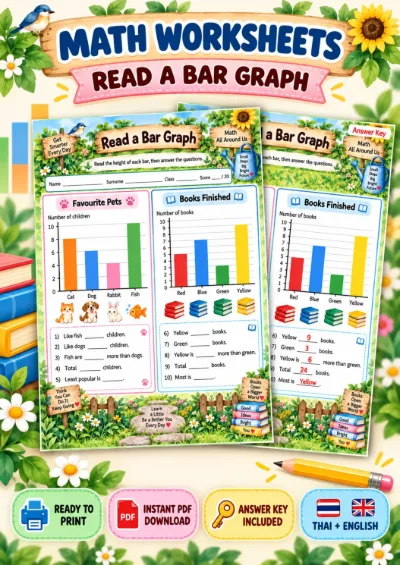
Grades 4–6 (P.4–P.6)
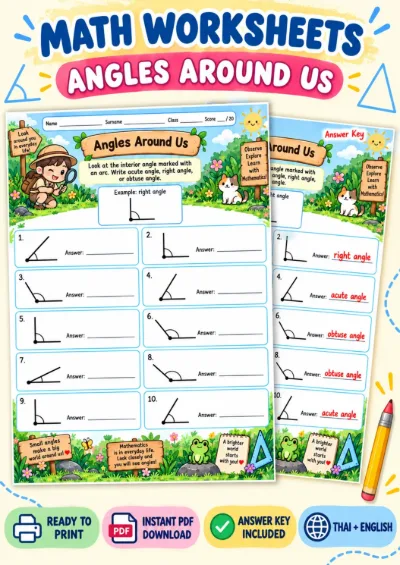
Grades 4–6 (P.4–P.6)
 Multiple choice
MathematicsGrade 16 questions
 Multiple choice
MathematicsGrade 16 questions
 Ordering
MathematicsGrade 14 rounds
 Sorting
MathematicsGrade 14 rounds