
Grades 4–6 (P.4–P.6)
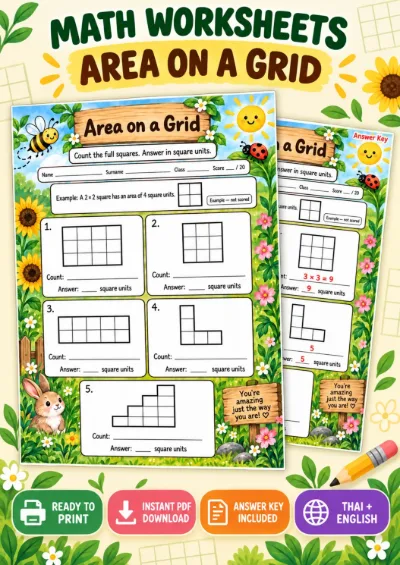
Area on a Grid - Count the Squares
19 Baht
View detailsMathematics
An AR classroom game for Grade 6. Learners can aim with their hands at the camera or play by tapping the screen.
This set has 4 rounds in an interactive sorting activity.
Curriculum indicatorค 1.1 ป.6/2
A look before you play
A few real prompts from the game to help you choose an activity for your class.
Sort into
A perfect square has an exact square root.
Sort into
Compare each probability with a half.
Sort into
A ratio compares two quantities; a percentage compares with a hundred.
Before you play
Classify perfect squares, events more or less likely than a half, ratio versus percentage problems (linked to ค 1.1 ป.6/2), and integers versus non-integers.
4 sorting rounds, dragging 4 cards into 2 groups - Perfect square or not: 64, 50, 100, 90 - More or less likely than a half: rolling more than 1, rolling a 6, two 1s in a row, heads or tails - Ratio or percentage: shared 2 : 3, 25% off, mixed 1 : 4, 90 out of 100 - Integer or not: -8, 2.5, 0, 1/3
Use as a short follow-on to CAT-02 or before probability; about 4-5 minutes. - Play in teams; in round 2 have teams count the faces that make the event happen, e.g. more than 1 is 5 faces out of 6 - In round 1, find which number times itself makes 64 and 100 - In round 4, ask whether 0 is an integer to start a discussion - Some items extend beyond primary indicators. Use them for discussion or preparation for Grade 7, not to judge attainment - Play it linked to the class to record results in the mark book.
- Round 4: 0 may go in the non-integer group because children think zero is nothing - Round 2: children may be unsure whether two 1s in a row or a single 6 is less likely, but both belong under less than half - Round 1: 50 and 90 may go with the perfect squares because they end in 0 like 100
Grades 4–6 (P.4–P.6)
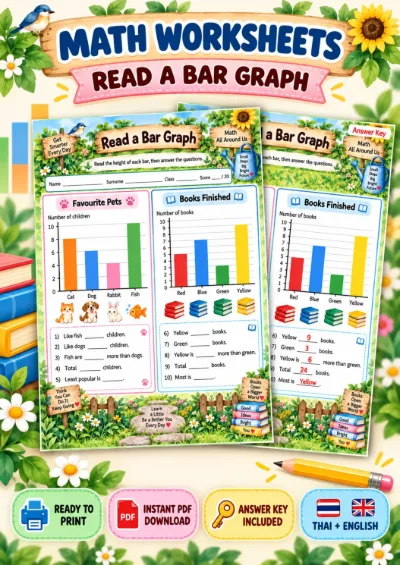
Grades 4–6 (P.4–P.6)
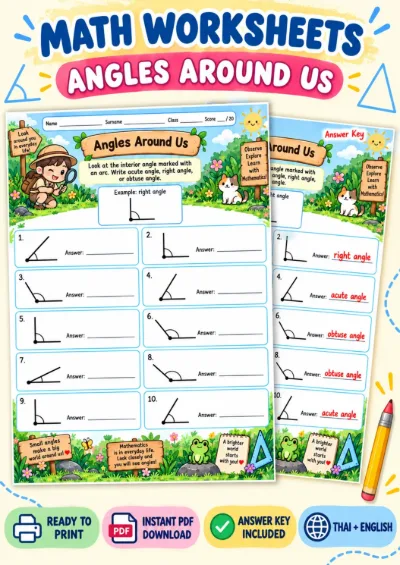
Grades 4–6 (P.4–P.6)
 Multiple choice
MathematicsGrade 16 questions
 Multiple choice
MathematicsGrade 16 questions
 Ordering
MathematicsGrade 14 rounds
 Sorting
MathematicsGrade 14 rounds