
Grades 1–3 (P.1–P.3)
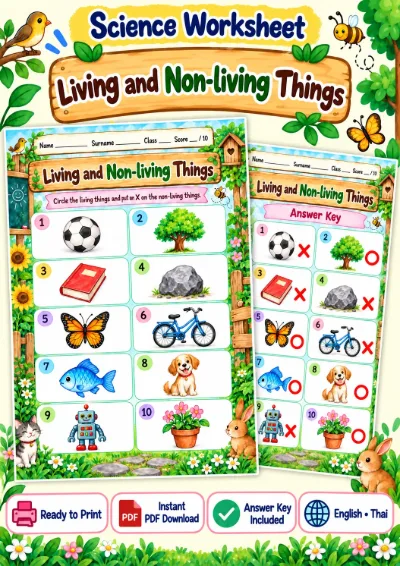
Living and Non-living Things - Circle and Cross
19 Baht
View detailsScience
An AR classroom game for Grade 2. Learners can aim with their hands at the camera or play by tapping the screen.
This set has 6 questions in an interactive multiple choice activity.
A look before you play
A few real prompts from the game to help you choose an activity for your class.
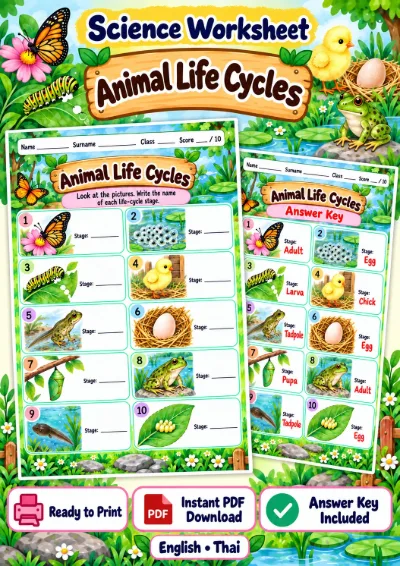
A tadpole is the second stage in a frog's life cycle.
Heated ice turns into water, which is a liquid.
The earth's gravity pulls everything towards the ground.
Before you play
A mixed Grade 2 science review: the tadpole in the frog's life, melting ice, gravity, how sound is made, which soil holds water, and what plants use to make food. Each item tests a different topic, so the set is not tied to any single indicator; use it as a general review.
6 questions, multiple choice with three options each - A tadpole is a stage of a frog - Melting ice becomes water (distractor: water vapour) - Sound is made by vibration - Clay holds water best; plants make food with sunlight, water and air
A 5-minute review before Grade 2 end-of-term tests; solo play gives individual results. For question 4, have children touch their throat and say a long aaa to feel the vibration. For question 5, recall the results if the class has poured water through three soils. On question 6, point out that soil and fertiliser are not the plant's food. You can link it to a class and record it in the gradebook. The in-game explanation for question 6 names carbon dioxide, which is beyond Grade 2; calling it a gas in the air is enough.
- Question 6: choosing soil and fertiliser, having seen adults feed plants. Separate them: fertiliser supplies minerals, food is made in the leaf. - Question 2: choosing water vapour because they see cold mist rising off ice. Explain that the white mist is tiny droplets; melting ice becomes water. - Question 5: choosing sandy soil because beach sand always seems wet. Recall the water-pouring test.
Grades 1–3 (P.1–P.3)
Grades 1–3 (P.1–P.3)
Grades 1–3 (P.1–P.3)
Grades 1–3 (P.1–P.3)
 Sorting
ScienceGrade 14 rounds
 Matching
ScienceGrade 14 rounds
 Multiple choice
ScienceGrade 16 questions
 Multiple choice
ScienceGrade 16 questions