
Grades 1–3 (P.1–P.3)
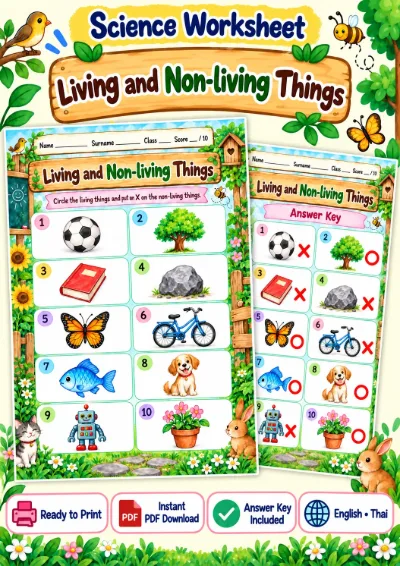
Living and Non-living Things - Circle and Cross
19 Baht
View detailsScience
An AR classroom game for Grade 1. Learners can aim with their hands at the camera or play by tapping the screen.
This set has 6 questions in an interactive multiple choice activity.
Curriculum indicatorว 3.1 ป.1/1
A look before you play
A few real prompts from the game to help you choose an activity for your class.
Before rain there are usually many clouds, making the sky dark and heavy.
The sun gives light and warmth during the day.
At night there is no sunlight, so we see the moon and the stars.
Before you play
Observing the sky and weather: what the sky looks like when it rains, what we see by day and by night, what wind does, the rainy season, and what to take when the sky darkens. Questions 2 and 3 match indicator ว 3.1 ป.1/1 (what appears in the day and night sky); wind and seasons have no Grade 1 indicator.
6 questions, multiple choice with three options each - When it rains the sky is very cloudy and dark - By day we see the Sun; at night we usually see the Moon and stars - Wind makes leaves stir - The rainy season has the most rain; take an umbrella when the sky turns dark
Play it after taking the class outside to look at the sky, about 4-5 minutes, in teams, with the teacher reading. After question 4, have children blow on paper or wave a fan to make leaves move. On question 2, if a child says they have seen the Moon in the daytime, praise the observation and confirm it is true. Follow up with a class weather chart for a week. You can link it to a class and record it in the gradebook.
- Question 2: children who have seen the Moon by day may choose the Moon, which matches what they observed. Explain that the Sun is the answer you can see clearly every day. - Question 1: choosing thin fluffy white clouds, knowing only that rain comes from clouds. Compare pictures of rain clouds and fair-weather clouds. - Question 4: choosing ice melts. Moving air really does make ice melt faster, so hear out a child who reasons this way, then point out that the clearest thing wind does is make leaves stir.
Grades 1–3 (P.1–P.3)
Grades 1–3 (P.1–P.3)
Grades 1–3 (P.1–P.3)
Grades 1–3 (P.1–P.3)
 Sorting
ScienceGrade 14 rounds
 Matching
ScienceGrade 14 rounds
 Multiple choice
ScienceGrade 16 questions
 Sorting
ScienceGrade 14 rounds