
Grades 1–3 (P.1–P.3)
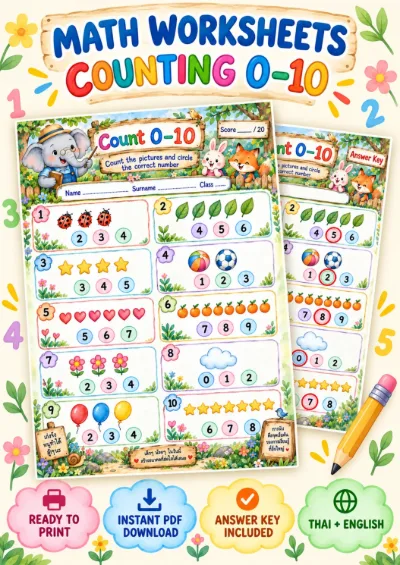
Count 0-10 - Count and Circle
19 Baht
View detailsMathematics
An AR classroom game for Grade 1. Learners can aim with their hands at the camera or play by tapping the screen.
This set has 4 rounds in an interactive sorting activity.
Curriculum indicatorค 1.1 ป.1/2
A look before you play
A few real prompts from the game to help you choose an activity for your class.
Sort into
Things you can eat and things you cannot.
Sort into
A one-digit number has one figure; a two-digit number has two.
Sort into
Shapes with corners and shapes without.
Before you play
Practise sorting by a clear rule: edible versus inedible things, one- versus two-digit numbers, shapes with and without corners, and addition versus subtraction sums.
4 rounds, a sorting game with 4 items each - Banana and rice are edible; pencil and eraser are not - 7 and 3 are one-digit; 12 and 18 are two-digit - Triangle and quadrilateral have corners; circle and oval do not - 3 + 2 and 4 + 5 are additions; 7 - 1 and 9 - 3 are subtractions
Use as a warm-up on sorting, 4-5 minutes, early in the year. - Play as a class; children state each round's rule before dragging, e.g. "This one is about whether we can eat it" - For round 4, trace the + and - signs with a finger on the screen - If many miss round 2, count how many digits each number has - Play it linked to a class and the scores go into the class gradebook.
- In round 3, putting the oval under has corners because its ends look pointed - In round 2, putting 12 or 18 under one-digit because สิบสอง is said as one word - In round 4, sorting by the answer instead of the sign, since other sets ask for results
Grades 1–3 (P.1–P.3)
Grades 1–3 (P.1–P.3)
Grades 1–3 (P.1–P.3)
Grades 1–3 (P.1–P.3)
 Multiple choice
MathematicsGrade 16 questions
 Multiple choice
MathematicsGrade 16 questions
 Ordering
MathematicsGrade 14 rounds
 Sorting
MathematicsGrade 14 rounds