
Grades 1–3 (P.1–P.3)
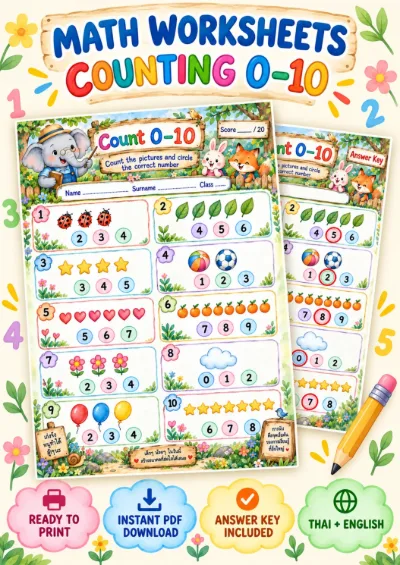
Count 0-10 - Count and Circle
19 Baht
View detailsMathematics
An AR classroom game for Grade 2. Learners can aim with their hands at the camera or play by tapping the screen.
This set has 4 rounds in an interactive ordering activity.
Curriculum indicatorค 1.2 ป.3/1
A look before you play
A few real prompts from the game to help you choose an activity for your class.
The five times table ends alternately in five and zero.
Adding ten raises the tens digit by one and leaves the ones unchanged.
Count back in twos from ten.
Before you play
Order numbers in patterns that go up in fives, up in tens and down in twos, and order two-digit numbers smallest to largest: skip counting that underpins the times tables and prepares for patterns that grow or shrink by equal steps (indicator ค 1.2 ป.3/1).
4 ordering questions - 5, 10, 15, 20 going up in fives - 10, 20, 30, 40 going up in tens - 10, 8, 6, 4 going down in twos - 19, 28, 37, 46 smallest to largest
A short 3-4 minute starter for a times-table lesson, solo mode. - Beforehand, hop along a floor number line in fives and in tens - Counting down in twos is the only backwards one; have pupils notice the word "down" - Afterwards, pupils make their own four-number pattern for a partner to order - Play it linked to the class to record results in the mark book
- Ordering the twos question as 4, 6, 8, 10 out of habit - In 19, 28, 37, 46, pupils who read the ones first think 19 is biggest because of the 9. Stress tens first - 10 and 20 appear in both the fives and tens patterns, which can confuse; take one question at a time
Grades 1–3 (P.1–P.3)
Grades 1–3 (P.1–P.3)
Grades 1–3 (P.1–P.3)
Grades 1–3 (P.1–P.3)
 Multiple choice
MathematicsGrade 16 questions
 Multiple choice
MathematicsGrade 16 questions
 Ordering
MathematicsGrade 14 rounds
 Sorting
MathematicsGrade 14 rounds