
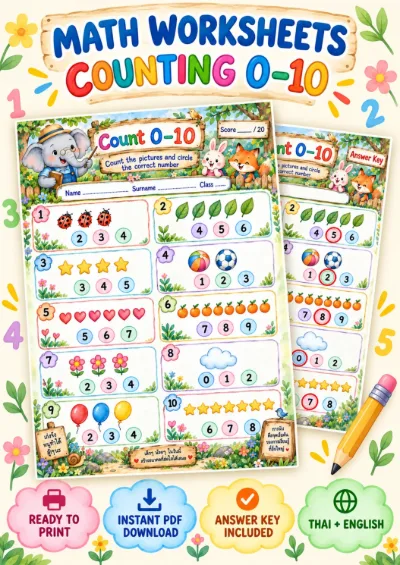
Grades 1–3 (P.1–P.3)
Count 0-10 - Count and Circle
19 Baht
View detailsMathematics
An AR classroom game for Grade 3. Learners can aim with their hands at the camera or play by tapping the screen.
This set has 6 questions in an interactive multiple choice activity.
Curriculum indicatorค 2.2 ป.4/1
A look before you play
A few real prompts from the game to help you choose an activity for your class.
The corner of a sheet of paper is a right angle - ninety degrees.
An acute angle is smaller than ninety degrees.
An obtuse angle lies between ninety and one hundred and eighty degrees.
Before you play
Recognise kinds of angle by comparing with a right angle (acute, right, obtuse) and know parallel lines, using everyday things such as a paper corner and clock hands, as groundwork for classifying angles in P4 (indicator ค 2.2 ป.4/1).
6 multiple-choice questions - The corner of a sheet of paper is a right angle - An angle smaller than a right angle is acute - An angle bigger than a right angle but less than a straight line is obtuse - A square has 4 right angles - Lines that never meet are parallel, and the clock hands at 3 o'clock make a right angle
Use as an enrichment activity once pupils have met right angles through rectangles, about 6 minutes, team mode. Give every team paper to fold into a right-angle tester. - For the clock question, set a teaching clock to 3 o'clock and hold the paper corner against it - Afterwards, hunt for parallel lines in the room, such as board edges and window rails - The on-screen explanations mention 90 and 180 degrees, which P3 pupils have not met; compare with the paper corner instead of using degrees - Play it linked to the class to record results in the mark book
- Swapping the names acute and obtuse. Link "acute" (แหลม) to a sharp pencil tip - Picking perpendicular for lines that never meet, having heard both words without the meanings. Draw both on the board - Picking straight angle for 3 o'clock, thinking of 6 o'clock
Grades 1–3 (P.1–P.3)
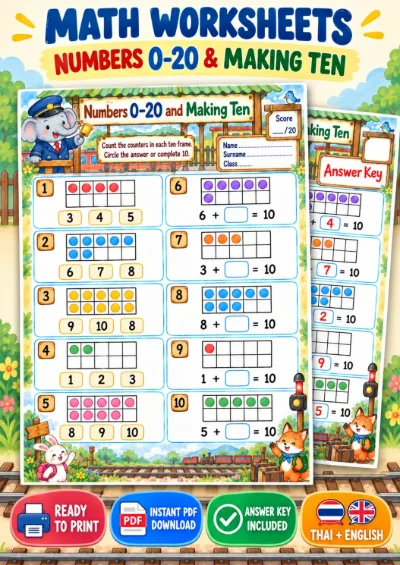
Grades 1–3 (P.1–P.3)
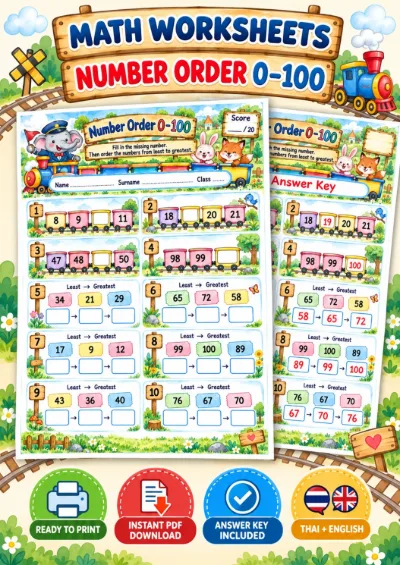
Grades 1–3 (P.1–P.3)
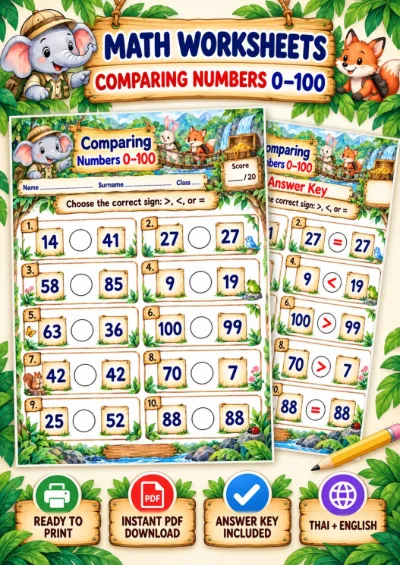
Grades 1–3 (P.1–P.3)
 Multiple choice
MathematicsGrade 16 questions
 Multiple choice
MathematicsGrade 16 questions
 Ordering
MathematicsGrade 14 rounds
 Sorting
MathematicsGrade 14 rounds