
Grades 1–3 (P.1–P.3)
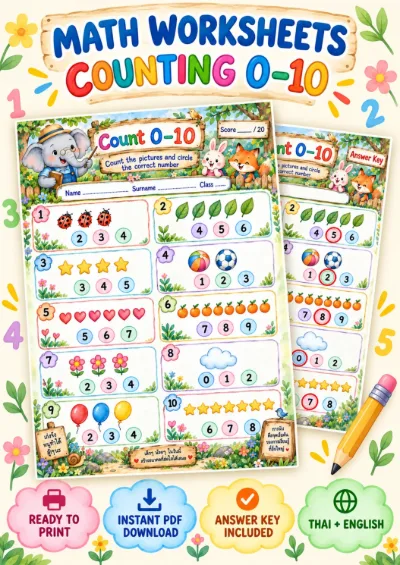
Count 0-10 - Count and Circle
19 Baht
View detailsMathematics
An AR classroom game for Grade 3. Learners can aim with their hands at the camera or play by tapping the screen.
This set has 4 rounds in an interactive sorting activity.
Curriculum indicatorค 1.1 ป.3/7
A look before you play
A few real prompts from the game to help you choose an activity for your class.
Sort into
Numbers in the eight times table and numbers that are not.
Sort into
Compare the hundreds with five - fewer than five hundreds means less than five hundred.
Sort into
Units for small things and units for large things, within the same system.
Before you play
Recognise numbers in the 8 times table, tell exact division from division with a remainder (indicator ค 1.1 ป.3/7), compare three-digit numbers with 500, and sort units for small or large quantities.
4 sorting questions with 2 boxes each - 16 and 40 are in the 8 times table; 18 and 42 are not - 199 and 450 are less than 500; 620 and 890 are more - Millilitre and millimetre are for small things; litre and kilometre for large things - 24 ÷ 6 and 40 ÷ 8 divide exactly; 25 ÷ 6 and 41 ÷ 8 leave a remainder
Use after the 8 times table and division with remainders, about 6 minutes, solo or pairs. - In the division question, point to 24 ÷ 6 and 25 ÷ 6: one more in the starting number leaves a remainder of 1 - For the 8 times table, leave the table on the board the first time through - For units, teach that the prefix milli- means small and kilo- means large - Play it linked to the class to record results in the mark book
- Putting 18 or 42 in the 8 times table because they are even and close to 16 and 40. Count up in eights to check - Putting 41 ÷ 8 under exact because 40 ÷ 8 is exact. Show 8 × 5 = 40 with 1 left over - Thinking litre is for small things because a 1-litre bottle is easy to hold. Compare with millilitres for medicine drops or a teaspoon
Grades 1–3 (P.1–P.3)
Grades 1–3 (P.1–P.3)
Grades 1–3 (P.1–P.3)
Grades 1–3 (P.1–P.3)
 Multiple choice
MathematicsGrade 16 questions
 Multiple choice
MathematicsGrade 16 questions
 Ordering
MathematicsGrade 14 rounds
 Sorting
MathematicsGrade 14 rounds