
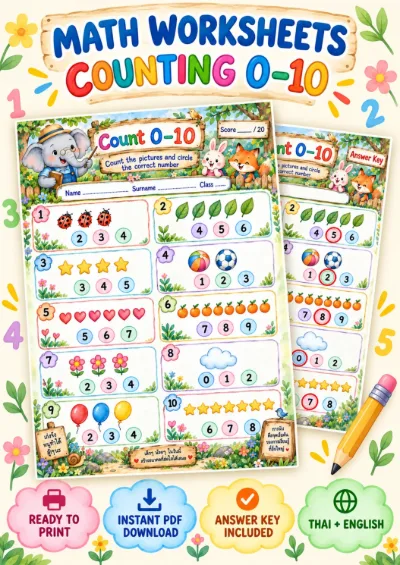
Grades 1–3 (P.1–P.3)
Count 0-10 - Count and Circle
19 Baht
View detailsMathematics
An AR classroom game for Grade 3. Learners can aim with their hands at the camera or play by tapping the screen.
This set has 4 rounds in an interactive sorting activity.
Curriculum indicatorค 1.1 ป.3/1
A look before you play
A few real prompts from the game to help you choose an activity for your class.
Sort into
An even number divides exactly by two - look at the ones digit: 0, 2, 4, 6 or 8 means even.
Sort into
The ones digit tells you - no need to read the whole number. 134 ends in four, so it is even.
Sort into
Zero is even, because it divides by two exactly with nothing left over.
Before you play
Tell odd from even for numbers into the hundreds by looking at the ones digit, know that 0 is even, and decide whether products are odd or even.
4 sorting questions, all odd or even - 12, 20 even; 7, 15 odd - 134, 308 even; 251, 479 odd - 0, 66 even; 1, 99 odd - 3 × 4, 2 × 9 even; 3 × 5, 7 × 7 odd
Use as early-P3 review, about 5 minutes, solo mode; the questions get harder in order. - For 0, discuss before revealing why it is even: 0 splits into two equal piles (that reason is enough at P3) - For products, work out each one first, then notice the rule that odd times odd is odd - Play it linked to the class to record results in the mark book
- Putting 0 under odd, or being unsure, because 0 does not feel like a number - Calling 251 and 479 even from the 2 or 4 in the hundreds. Cover the hundreds and tens and look only at the ones - Putting 3 × 4 under odd because of the 3. Work out 12 first
Grades 1–3 (P.1–P.3)
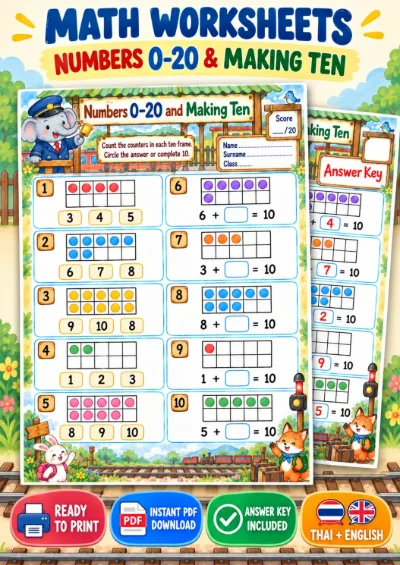
Grades 1–3 (P.1–P.3)
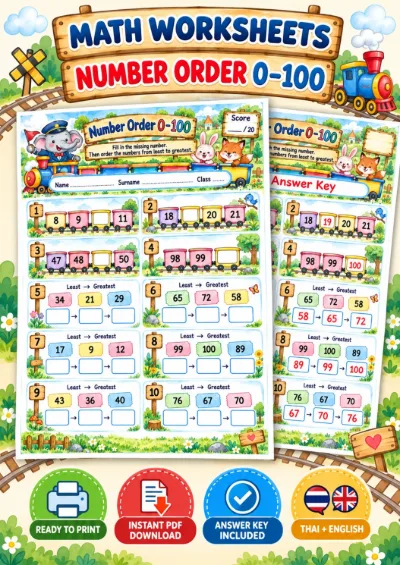
Grades 1–3 (P.1–P.3)
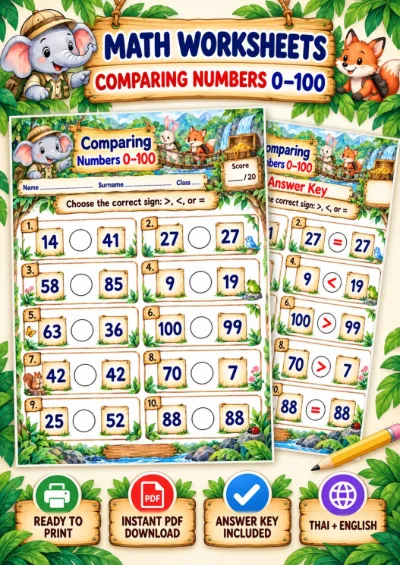
Grades 1–3 (P.1–P.3)
 Multiple choice
MathematicsGrade 16 questions
 Multiple choice
MathematicsGrade 16 questions
 Ordering
MathematicsGrade 14 rounds
 Sorting
MathematicsGrade 14 rounds