
Grades 1–3 (P.1–P.3)
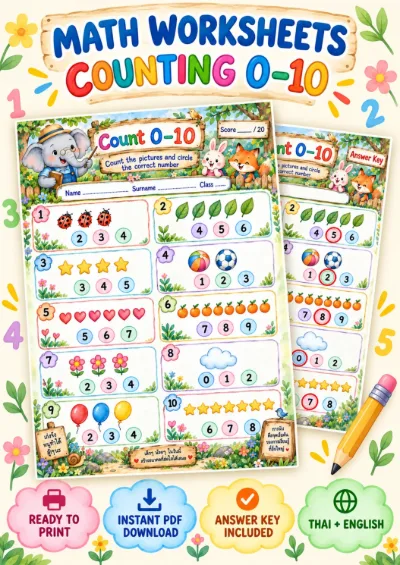
Count 0-10 - Count and Circle
19 Baht
View detailsMathematics
An AR classroom game for Grade 3. Learners can aim with their hands at the camera or play by tapping the screen.
This set has 4 rounds in an interactive ordering activity.
Curriculum indicatorค 1.2 ป.3/1
A look before you play
A few real prompts from the game to help you choose an activity for your class.
Three times two, three, four and five gives six, nine, twelve, fifteen.
Four times two, three, four and five gives eight, twelve, sixteen, twenty.
Compare the hundreds first; if they match, look at the tens.
Before you play
Order products of the 3 and 4 tables as patterns (indicator ค 1.2 ป.3/1), order three-digit numbers made from the same digits largest first, and remember the long-division cycle: divide, multiply, subtract, bring down (ค 1.1 ป.3/7).
4 ordering questions - 6, 9, 12, 15 from the 3 times table - 8, 12, 16, 20 from the 4 times table - 540, 450, 405, 354 largest to smallest - Long division steps: divide, multiply, subtract, bring the next digit down
Use in the lesson that introduces long division, about 5 minutes, team mode. - After Q4, have teams work 84 ÷ 4 on paper, naming each step in the order they just set - For 540, 450, 405, 354, discuss how swapping the 5 and 4 changes the value - Keep "divide, multiply, subtract, bring down" on the board for the whole unit - Play it linked to the class to record results in the mark book
- In the long-division steps, putting "subtract" before "multiply", not yet seeing that you multiply back to find how much was used. Work a real example step by step - Swapping 405 and 450, which use the same digits. Compare the tens, 0 and 5 - Placing 354 before 405 because its tens digit 5 beats 0; the hundreds must be compared first
Grades 1–3 (P.1–P.3)
Grades 1–3 (P.1–P.3)
Grades 1–3 (P.1–P.3)
Grades 1–3 (P.1–P.3)
 Multiple choice
MathematicsGrade 16 questions
 Multiple choice
MathematicsGrade 16 questions
 Ordering
MathematicsGrade 14 rounds
 Sorting
MathematicsGrade 14 rounds