
Grades 4–6 (P.4–P.6)
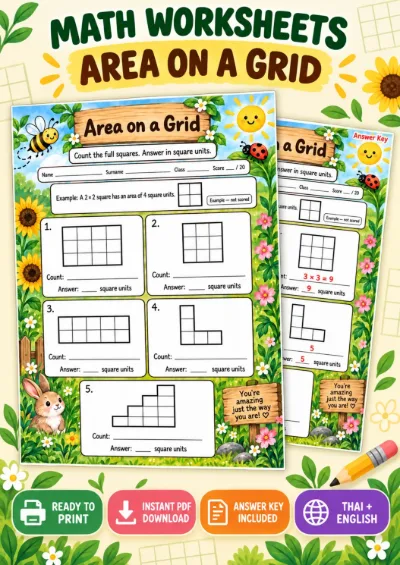
Area on a Grid - Count the Squares
19 Baht
View detailsMathematics
An AR classroom game for Grade 4. Learners can aim with their hands at the camera or play by tapping the screen.
This set has 4 rounds in an interactive matching activity.
Curriculum indicatorค 1.1 ป.4/9
A look before you play
A few real prompts from the game to help you choose an activity for your class.
Multiplying a two-digit number by a single digit.
Round to the nearest ten.
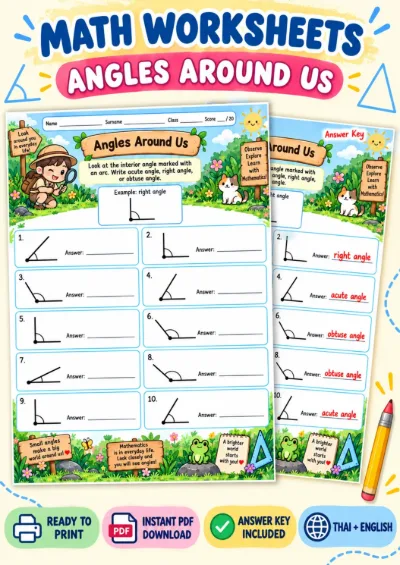
Classify angles by their size, using ninety and one hundred and eighty as the marks.
Before you play
Multiply two-digit by one-digit numbers (indicator ค 1.1 ป.4/9), round to the nearest ten (indicator ค 1.1 ป.4/7), classify angles by their degrees (ค 2.2 ป.4/1), and match units to what they measure.
4 matching questions - 14 × 3 = 42, 16 × 4 = 64, 21 × 5 = 105, 18 × 2 = 36 - Round 23 to 20, 38 to 40, 51 to 50, 67 to 70 - 45 degrees acute, 90 right, 120 obtuse, 180 straight - Square centimetre with area, millilitre with volume of liquid
Use for P4 mid-term review, about 6 minutes, team mode. - For rounding, draw a 20 to 70 number line and have teams point to the nearest ten for each number - 21 × 5 = 105 is the only three-digit product - For angles, teams draw 120 degrees with a protractor next to 90 degrees - Play it linked to the class to record results in the mark book
- For 16 × 4 and 14 × 3, forgetting to carry gives 44 or 32, which are not on the cards, so pupils guess. Work on paper - Rounding 51 up to 60, thinking rounding always goes up. Use the number line - Not knowing 180 degrees is a straight angle because it looks like a line. Open a book until it lies flat
Grades 4–6 (P.4–P.6)
Grades 4–6 (P.4–P.6)
Grades 4–6 (P.4–P.6)
 Multiple choice
MathematicsGrade 16 questions
 Multiple choice
MathematicsGrade 16 questions
 Ordering
MathematicsGrade 14 rounds
 Sorting
MathematicsGrade 14 rounds