
Grades 4–6 (P.4–P.6)
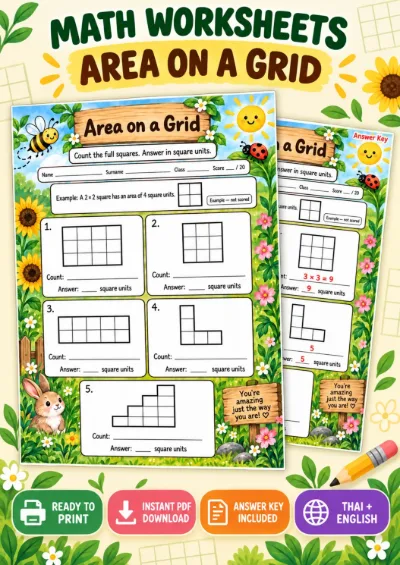
Area on a Grid - Count the Squares
19 Baht
View detailsMathematics
An AR classroom game for Grade 4. Learners can aim with their hands at the camera or play by tapping the screen.
This set has 4 rounds in an interactive ordering activity.
Curriculum indicatorค 1.1 ป.4/11
A look before you play
A few real prompts from the game to help you choose an activity for your class.
Read it properly first so you know what is being asked, then choose the method.
The tops match; the bigger the bottom, the smaller the piece - so order by bottom, largest first.
Count the digits first, then compare place by place from the left.
Before you play
Order the steps for solving a word problem (indicator ค 1.1 ป.4/11) and for finding a rectangle's area (indicator ค 2.1 ป.4/3), order unit fractions (ค 1.1 ป.4/4), and order numbers with different numbers of digits.
4 ordering questions - Read the problem carefully, work out what it asks, choose the method, check the answer - 1/8, 1/5, 1/3, 1/2 smallest to largest - 456, 1205, 3400, 12000 smallest to largest - Measure the width, measure the length, multiply, write the answer in square units
Use at the start of a word-problem unit to set the steps the class will use all year, about 5 minutes, team mode. - After Q1, post the four steps on the wall and use them for every problem in the unit - After the area question, teams measure a desk or exercise book and find its area following the steps - For fractions, compare 1/8 and 1/2 with fraction strips - Play it linked to the class to record results in the mark book
- Swapping "read the problem" and "work out what it asks", which happen together while reading; accept the reasoning - Swapping width and length in the area steps, which can be measured in either order; value the reasoning over the order, since the game accepts only one - Putting 1/2 first, thinking a small bottom number means a small fraction - Swapping 12000 and 1205, which both start with 1 and 2. Count the digits first
Grades 4–6 (P.4–P.6)
Grades 4–6 (P.4–P.6)
Grades 4–6 (P.4–P.6)
 Multiple choice
MathematicsGrade 16 questions
 Multiple choice
MathematicsGrade 16 questions
 Ordering
MathematicsGrade 14 rounds
 Sorting
MathematicsGrade 14 rounds