
Grades 4–6 (P.4–P.6)
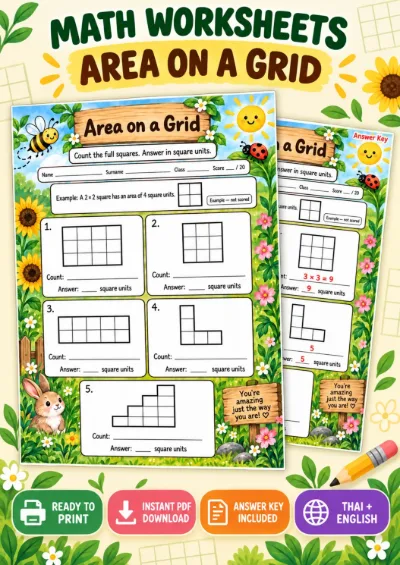
Area on a Grid - Count the Squares
19 Baht
View detailsMathematics
An AR classroom game for Grade 5. Learners can aim with their hands at the camera or play by tapping the screen.
This set has 6 questions in an interactive multiple choice activity.
Curriculum indicatorค 2.2 ป.5/1
A look before you play
A few real prompts from the game to help you choose an activity for your class.
A regular hexagon has six lines of symmetry.
A parallelogram has both pairs of opposite sides parallel.
A trapezium has just one pair of parallel sides.
Before you play
Name properties of polygons: lines of symmetry, how many pairs of parallel sides parallelograms and trapeziums have (linked to ค 2.2 ป.5/2), and interior angle totals by splitting into triangles.
6 questions, multiple choice with 3 options - Lines of symmetry of a regular hexagon (6) - Which shape has two pairs of parallel sides (parallelogram) - Pairs of parallel sides in a trapezium (1) - Which shape's interior angles total 540 degrees (pentagon) - Lines of symmetry of an isosceles triangle (1)
Use after classifying quadrilaterals, as a stretch game for confident pupils; about 6-8 minutes. - Play in teams and hand out paper hexagons and isosceles triangles to fold for real lines of symmetry - If many miss Q4 and Q6, draw diagonals from one corner of a pentagon on the board and count the 3 triangles - For Q1, have children fold rather than guess - Play it linked to the class to record results in the mark book.
- Q1: children may answer 3, counting only lines through corners, or 12, counting lines twice - Q6: 900 or 540 come from miscounting triangles; the number of triangles is the number of sides minus 2 - Q2: the trapezium is a strong distractor, as children remember it has parallel sides but forget it has only one pair
Grades 4–6 (P.4–P.6)
Grades 4–6 (P.4–P.6)
Grades 4–6 (P.4–P.6)
 Multiple choice
MathematicsGrade 16 questions
 Multiple choice
MathematicsGrade 16 questions
 Ordering
MathematicsGrade 14 rounds
 Sorting
MathematicsGrade 14 rounds