
Grades 4–6 (P.4–P.6)
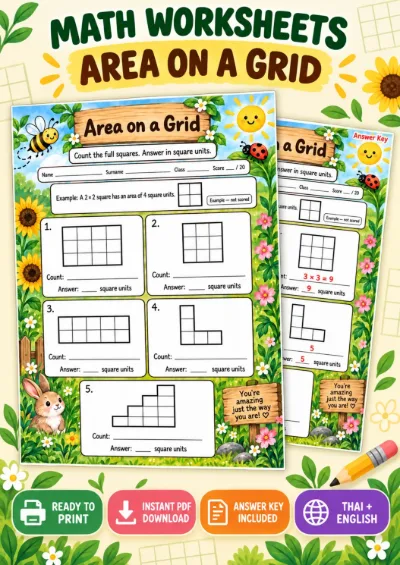
Area on a Grid - Count the Squares
19 Baht
View detailsMathematics
An AR classroom game for Grade 5. Learners can aim with their hands at the camera or play by tapping the screen.
This set has 4 rounds in an interactive ordering activity.
Curriculum indicatorค 1.1 ป.5/3
A look before you play
A few real prompts from the game to help you choose an activity for your class.
The first four primes are two, three, five and seven.
Convert them all to minutes before comparing.
Percentages can be compared directly.
Before you play
Order the first four primes, order times written in different units, order percentages, and put the steps of finding the lowest common multiple by listing multiples in order.
4 ordering rounds of 4 cards - Primes smallest first: 2, 3, 5, 7 - Shortest to longest: 30 minutes, 1 hour, 90 minutes, 2 hours - Percentages smallest first: 10%, 25%, 50%, 75% - Steps for the LCM: list multiples of the first number, list multiples of the second, find the shared ones, take the smallest
Use as a warm-up before teaching the LCM; about 4 minutes. - Play as a class on the projector and use round 4 as the lead-in, working 4 and 6 on the board after the answer - In round 2, have children convert every card to minutes first - After round 1, ask whether 1 is prime and why it is not in the set - Play it linked to the class to record results in the mark book.
- Round 2: 90 minutes may be put after 2 hours because 90 is a big number, if units are not converted - Round 4: listing the multiples of the first and second numbers can be done in either order, so children who swap them may lose marks - Round 1: some think 2 is not prime because it is even
Grades 4–6 (P.4–P.6)
Grades 4–6 (P.4–P.6)
Grades 4–6 (P.4–P.6)
 Multiple choice
MathematicsGrade 16 questions
 Multiple choice
MathematicsGrade 16 questions
 Ordering
MathematicsGrade 14 rounds
 Sorting
MathematicsGrade 14 rounds