
Grades 4–6 (P.4–P.6)
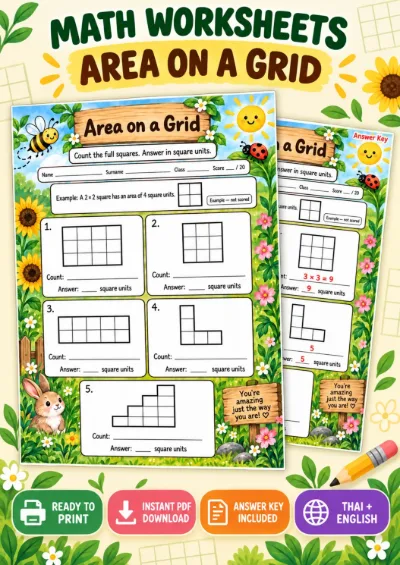
Area on a Grid - Count the Squares
19 Baht
View detailsMathematics
An AR classroom game for Grade 5. Learners can aim with their hands at the camera or play by tapping the screen.
This set has 4 rounds in an interactive sorting activity.
Curriculum indicatorค 1.1 ป.5/2
A look before you play
A few real prompts from the game to help you choose an activity for your class.
Sort into
A prime number has only one and itself as factors.
Sort into
A number divides by three exactly when the sum of all its digits does.
Sort into
Compare with one: a decimal with no whole number in front is always less than one.
Before you play
Classify prime numbers, numbers that divide exactly by 3, decimals below or above 1, and two-dimensional versus three-dimensional figures.
4 sorting rounds, dragging 4 cards into 2 groups - Prime or not: 7, 9, 11, 15 - Divides exactly by 3 or not: 12, 14, 27, 20 - Less or more than 1: 0.8, 1.5, 0.95, 2.1 - Two- or three-dimensional: circle, sphere, square, cube
Use as a review before prisms and 3D shapes; about 4 minutes. - Solo mode is fine since each round has few cards - For round 4, hold up a ball and draw a circle on the board to show sphere versus circle - If round 1 goes badly, point out 9 = 3 × 3 and 15 = 3 × 5; not every odd number is prime - Play it linked to the class to record results in the mark book.
- Round 1: 9 and 15 go in the prime group because they are odd - Round 4: circle and sphere are confused because the Thai names are similar, and the cube may go in the 2D group because children picture its square face - Round 3: 0.95 may go above 1 because 95 is a big number
Grades 4–6 (P.4–P.6)
Grades 4–6 (P.4–P.6)
Grades 4–6 (P.4–P.6)
 Multiple choice
MathematicsGrade 16 questions
 Multiple choice
MathematicsGrade 16 questions
 Ordering
MathematicsGrade 14 rounds
 Sorting
MathematicsGrade 14 rounds