
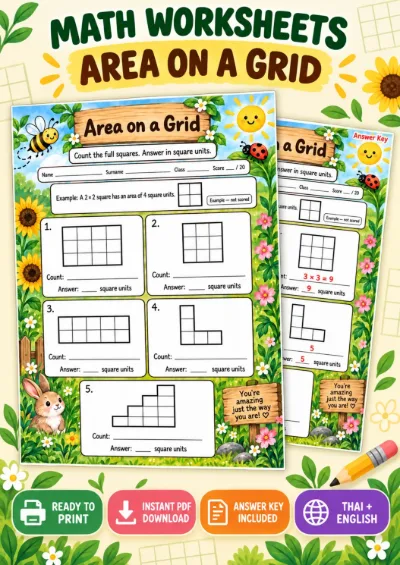
Grades 4–6 (P.4–P.6)
Area on a Grid - Count the Squares
19 Baht
View detailsMathematics
An AR classroom game for Grade 6. Learners can aim with their hands at the camera or play by tapping the screen.
This set has 6 questions in an interactive multiple choice activity.
Curriculum indicatorค 2.1 ป.6/2
A look before you play
A few real prompts from the game to help you choose an activity for your class.
The diameter is always twice the radius: five times two is ten.
A cube's volume is side times side times side: three times three times three is twenty-seven.
A cuboid's volume is width times length times height: two times five times four is forty.
Before you play
Practise the radius-diameter relationship, find a circle's circumference with pi as 22/7 (ค 2.1 ป.6/3), find the volume of cubes and cuboids, and describe a cylinder.
6 questions, multiple choice with 3 options - Diameter of a circle of radius 5 (10) - Volume of a cube with edges of 3 (27) - Radius of a circle of diameter 14 (7) - Circumference of a circle of radius 7 with pi as 22/7 (44) - How many edges a cylinder has (2)
Use after teaching the parts of a circle; about 5-6 minutes. - Play solo, with paper plates and string to measure a real circumference before Q5 - For Q1 and Q4, draw a circle on the board with radius and diameter in different colours - For Q6, trace the top and bottom rims of a can. Accept either 0 straight edges or 2 curved rims, depending on the definition, and do not score this item from the game - Play it linked to the class to record results in the mark book.
- Q1: radius and diameter swapped, giving 5 or 25 - Q5: using the area formula gives 154, which is not offered, so children guess 49 - Q2: 9 (3 × 3) from thinking of one face - Q6: answers of 0 or 3 are possible because what counts as an edge is unclear
Grades 4–6 (P.4–P.6)
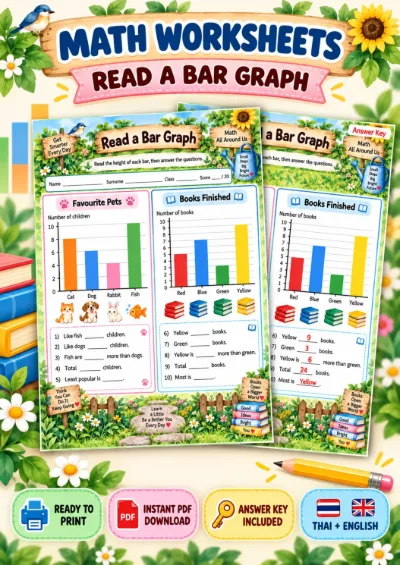
Grades 4–6 (P.4–P.6)
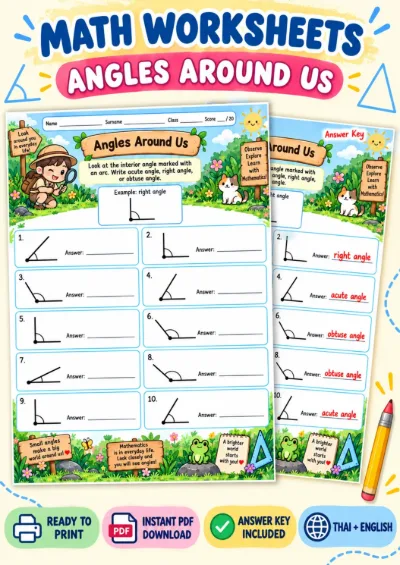
Grades 4–6 (P.4–P.6)
 Multiple choice
MathematicsGrade 16 questions
 Multiple choice
MathematicsGrade 16 questions
 Ordering
MathematicsGrade 14 rounds
 Sorting
MathematicsGrade 14 rounds