
Grades 4–6 (P.4–P.6)
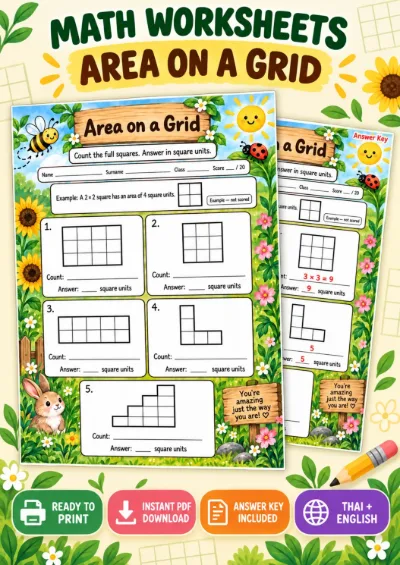
Area on a Grid - Count the Squares
19 Baht
View detailsMathematics
An AR classroom game for Grade 6. Learners can aim with their hands at the camera or play by tapping the screen.
This set has 4 rounds in an interactive matching activity.
Curriculum indicatorค 1.1 ป.6/6
A look before you play
A few real prompts from the game to help you choose an activity for your class.
A percentage is hundredths; simplified, it is easier to remember.
Divide both sides by the highest common factor.
Solve step by step: move terms across, then divide.
Before you play
Match percentages to simplest fractions, simplify ratios using the HCF (ค 1.1 ป.6/3 and ป.6/4), solve simple equations, and match units to what they measure.
4 matching rounds of 4 pairs each - Percentage to simplest fraction: 20% with 1/5, 75% with 3/4 - Ratio in simplest form: 9 : 12 with 3 : 4, 10 : 15 with 2 : 3, 6 : 30 with 1 : 5 - Equation to solution: 2x = 16 with 8, x ÷ 3 = 2 with 6 - Unit to what it measures: cubic metre with pool water, km per hour with a car's speed
Use as a review after ratios; about 5 minutes. - Play in teams; in round 2 have teams find the HCF of each pair first - In round 3, check by substituting, e.g. 6 ÷ 3 = 2 - If round 2 goes badly, work 9 : 12 together on the board, dividing both by 3 - Some items extend beyond primary indicators. Use them for discussion or preparation for Grade 7, not to judge attainment - Play it linked to the class to record results in the mark book.
- Round 2: 9 : 12 and 10 : 15 get swapped because 3 : 4 and 2 : 3 look alike - Round 3: x ÷ 3 = 2 may be paired with 7 or 9 by adding or subtracting instead of multiplying - Round 1: 20% may be paired with 1/4 by children who think a quarter is 20%
Grades 4–6 (P.4–P.6)
Grades 4–6 (P.4–P.6)
Grades 4–6 (P.4–P.6)
 Multiple choice
MathematicsGrade 16 questions
 Multiple choice
MathematicsGrade 16 questions
 Ordering
MathematicsGrade 14 rounds
 Sorting
MathematicsGrade 14 rounds