
Grades 4–6 (P.4–P.6)
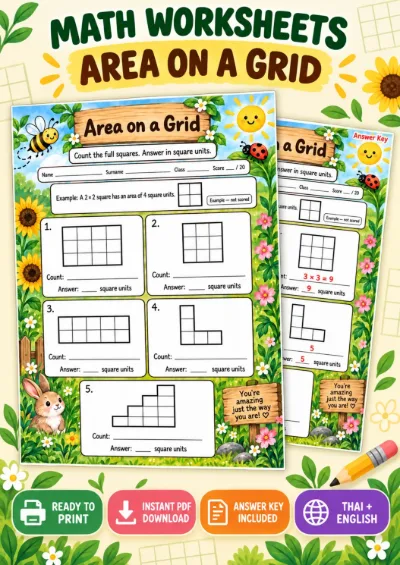
Area on a Grid - Count the Squares
19 Baht
View detailsMathematics
An AR classroom game for Grade 6. Learners can aim with their hands at the camera or play by tapping the screen.
This set has 4 rounds in an interactive ordering activity.
Curriculum indicatorค 1.1 ป.6/8
A look before you play
A few real prompts from the game to help you choose an activity for your class.
Brackets always come first, then powers, then multiplication and division, then addition and subtraction.
Make the bottoms match first, then compare the tops.
With negatives, the bigger the figure the smaller the value - it sits further left of zero.
Before you play
Practise the order of operations (brackets, powers, multiply and divide, add and subtract), order fractions as in ค 1.1 ป.6/1, order numbers including negatives, and put the steps for finding a mean in order.
4 ordering rounds of 4 cards - Order of operations: brackets, powers, multiplication and division, addition and subtraction - Fractions smallest first: 1/6, 1/3, 1/2, 2/3 - Numbers smallest first: -5, -2, 0, 3 - Steps for the mean: add all values, count them, divide total by count, give the unit
Use before mixed operations with fractions (ค 1.1 ป.6/7); about 4-5 minutes. - Play as a class on the projector; after round 1 work out 2 + 3 × 4 together to get 14, not 20 - In round 2, rewrite all as sixths: 1/6, 2/6, 3/6, 4/6 - In round 4, if a team counts before adding, accept in discussion that it works just as well - Some items extend beyond primary indicators. Use them for discussion or preparation for Grade 7, not to judge attainment - Play it linked to the class to record results in the mark book.
- Round 3: -5 and -2 swapped because 5 is bigger than 2 - Round 1: add/subtract placed before multiply/divide by children used to working left to right - Round 2: 1/6 placed last because 6 is the biggest denominator - Round 4: adding the values and counting them can be swapped, so children who swap lose marks
Grades 4–6 (P.4–P.6)
Grades 4–6 (P.4–P.6)
Grades 4–6 (P.4–P.6)
 Multiple choice
MathematicsGrade 16 questions
 Multiple choice
MathematicsGrade 16 questions
 Ordering
MathematicsGrade 14 rounds
 Sorting
MathematicsGrade 14 rounds