
Grades 4–6 (P.4–P.6)
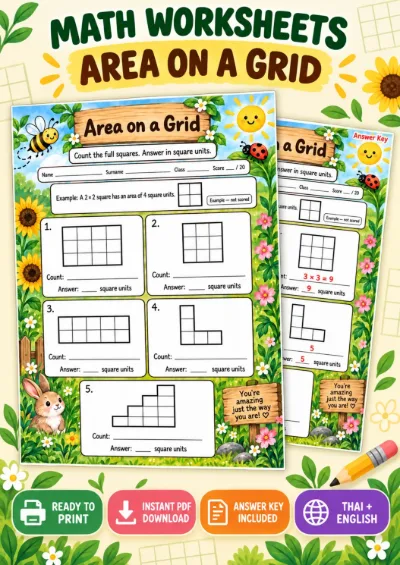
Area on a Grid - Count the Squares
19 Baht
View detailsMathematics
An AR classroom game for Grade 6. Learners can aim with their hands at the camera or play by tapping the screen.
This set has 4 rounds in an interactive ordering activity.
Curriculum indicatorค 1.1 ป.6/8
A look before you play
A few real prompts from the game to help you choose an activity for your class.
Work out each value first, then put them in order.
Convert them to decimals before comparing.
Negatives come first, then zero, then positives.
Before you play
Order powers by value, order probabilities from 1/6 up to 1, order numbers including negatives, and put the steps for finding a probability in order.
4 ordering rounds of 4 cards - Powers smallest first: 2^2, 3^2, 2^4, 5^2 - Probabilities smallest first: 1/6, 1/3, 1/2, 1 - Numbers smallest first: -10, -1, 0, 5 - Steps for a probability: count all outcomes, count wanted outcomes, write a fraction, simplify
Use as enrichment after introducing powers and probability; about 4-5 minutes. - Play in teams; in round 1 have teams write the values under the cards first: 4, 9, 16, 25 - In round 2, draw a 0 to 1 probability line on the board and place the cards - In round 4, if a team counts wanted outcomes first, discuss that the answer is the same - Play it linked to the class to record results in the mark book.
- Round 1: 2^4 put before 3^2 by looking only at the base, or by thinking 2^4 is 8 - Round 3: -10 and -1 swapped because 10 is bigger than 1 - Round 2: 1/6 and 1/3 swapped because 6 is bigger than 3 - Round 4: the first two steps can be swapped, so children who swap lose marks
Grades 4–6 (P.4–P.6)
Grades 4–6 (P.4–P.6)
Grades 4–6 (P.4–P.6)
 Multiple choice
MathematicsGrade 16 questions
 Multiple choice
MathematicsGrade 16 questions
 Ordering
MathematicsGrade 14 rounds
 Sorting
MathematicsGrade 14 rounds