

If you want a lesson where every child joins in, teach animals. Children this age already love animals and already know a great deal about them, and no other topic gives you this much room for noises and actions. In a classroom where the teacher is willing to do the monkey noise, nobody ever forgets the word monkey.
Split the Words Into Three Groups by Familiarity
- Pets and animals close to home: cat, dog, bird, fish, rabbit. Start here, because children have seen these for real.
- Farm animals: cow, pig, duck, chicken, horse. Build on these with the noise each one makes.
- Wild and zoo animals: lion, tiger, elephant, monkey, bear, snake. This is the group children love most, so save it as a reward.

A Game With Nothing to Prepare: What Am I?
You or one of the children acts out an animal, complete with the sound it makes, and the rest guess in English. There's one rule: the answer has to be a full sentence, 'It is a cat!' The game drills vocabulary and the a and an sentence frame at the same time, and nobody in the room notices they're doing grammar.
A harder version for Grade 3: add an adjective. 'It is a big elephant.' 'It is a small bird.' Now one game covers animals and sizes together.
Get It Onto Paper So It Stays
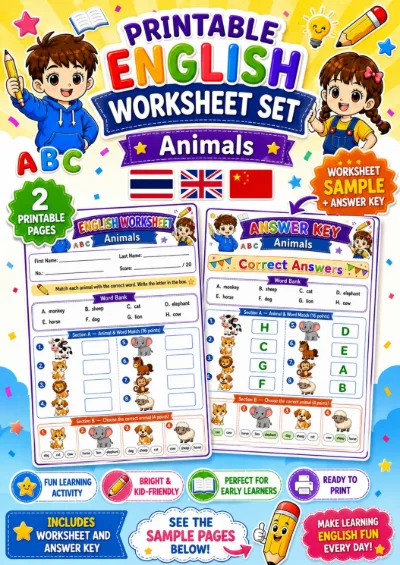
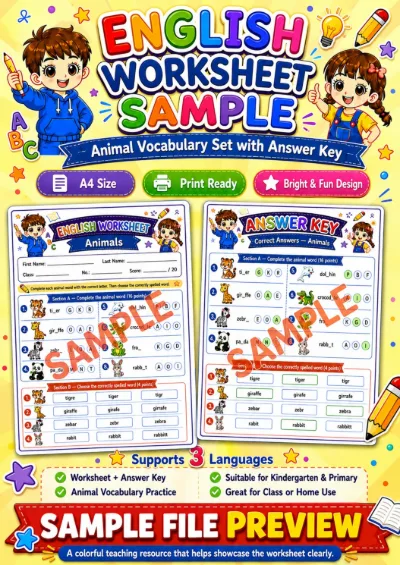
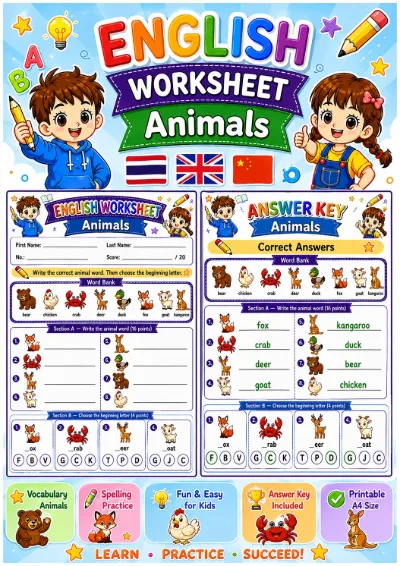
After the game, the children need to write. What they remember from a bit of fun fades fast if nothing gets written down. A worksheet matching animal pictures to words, followed by one that asks them to fill in the missing letter (c_t, d_g), is the right order for this age. And the homework children in this topic do most willingly of all: draw your favourite animal and write its English name underneath.
Worksheets from this article
Grades 1–3 (P.1–P.3)
Animals - Match the Animals and Words
Grades 1–3 (P.1–P.3)
Animals - Spell the Animal Words
Grades 1–3 (P.1–P.3)