

Two weeks before the final exam, many teachers hand out a thick review booklet. Children complete every page, the teacher marks every item, and the exam scores come out about where everyone expected. The strong children do well and the shaky ones stay shaky. The booklet is not wrong. It reviews every topic equally, both what children know and what they do not.
This plan uses the last ten school days to measure first which topics the class is still shaky on, then spend most of the time there, alternating worksheets with AR games. It works for Grades 1 to 6 and for both semester 1 and semester 2 finals. Adjust the number of days to your school's exam calendar.
Four principles before planning
- Make children pull knowledge out themselves: a large body of learning research finds that answering questions from memory builds longer-lasting recall than rereading notes. Almost all review in this plan is answering questions, not rereading.
- Measure first, then review only the gaps: teachers feel the class is weak on many topics, but results usually point to a few. One day of measuring saves several days of review.
- Mix topics in the second week: the real exam does not label what each question is about. Children need practice choosing a method from mixed questions.
- Review is not a test: tell children clearly that nothing in these two weeks is graded. Children afraid of mistakes will try more, and you will see what they really do not know.
Day 1: measure the class with a game, individuals with a worksheet
Open the grade's AR review set in classroom mode, one set per subject, six questions each, no more than five minutes. The end-of-game summary shows for each question how many answered correctly, incorrectly or not at all. Note every question more than half the class got wrong. Those are the topics to reteach to everyone.
The game summary shows the whole class but not who is shaky. On the same day, give a one-page worksheet per subject. Examples that work well as checks:
- Maths Grades 1 to 3: the missing number worksheet and the mixed addition and subtraction choose-the-sign worksheet. Both show whether children understand what the signs mean or can only calculate.
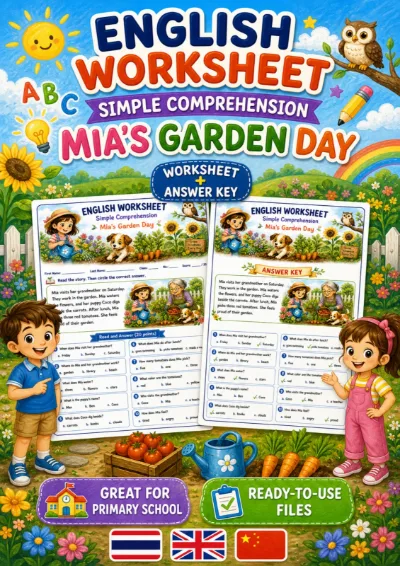
- English Grades 1 to 3: the simple comprehension worksheet where children read a story and circle the answer.
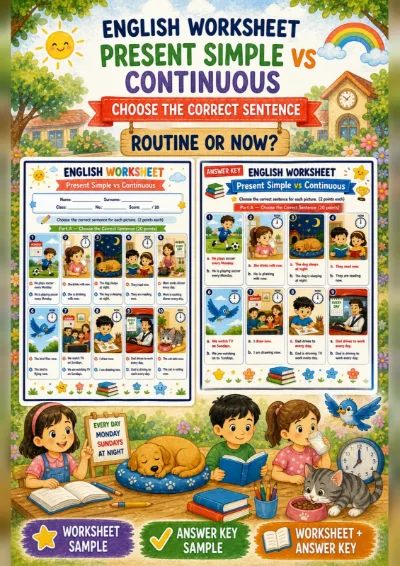
- English Grades 4 to 6: the Present Simple vs Continuous choose-the-sentence worksheet and the main idea and details worksheet.
- Science: one worksheet from a unit taught this semester, such as force and movement or solids, liquids and gases.
Review sets in the AR library by grade
The AR library has a review set for each grade, six questions each. The examples below use the set names shown in the library.
- Grade 1: maths add and subtract within 10 and even numbers / English numbers, family, greetings / science living things, plants and shadows / for Thai, the simple reading comprehension set
- Grade 2: maths addition with carrying and times tables / English is are has can / science life cycles, force and sound / for Thai, the short story reading set
- Grade 3: maths multiplication, division, fractions and time / English There are, has, must / science light, electricity, day and night / Thai final consonants, idioms, royal vocabulary
- Grade 4: maths multiplication, division, fractions, decimals / English present tenses and How many / science plants, circuits, food chains / Thai classifiers, sentences, idioms
- Grade 5: maths percentages, area, volume / English past tense and comparatives / science heart, pressure, sound, rust / Thai compound words, royal vocabulary, verse
- Grade 6: maths integers, equations, percentages / English Perfect and Passive / science heredity, parallel circuits, rocks / Thai doublet words, idioms, verse forms
One caution matters a lot. Each grade's review set covers the whole year. Used before the semester 1 final, it may include semester 2 content your class has not met. Open every question before using a set. If a question covers something not yet taught, tell children before starting that they can skip it, and leave it out when reading the results. Otherwise a question the whole class missed looks like a gap when it is really an untaught topic.
Day 2: a one-page gap table
Turn Day 1 results into a single table. Rows are the topics on the exam; columns are three states: the class can do it, partly, not yet. Write the names of children who cannot do it yet, from the worksheets, in that topic's row. The table shows which topics need reteaching to everyone and which affect only a few children.
In most classes the table shows two or three topics per subject that need whole-class reteaching and a few where a small group is stuck. The rest need no more time.
Days 3 to 5: reteach only what the table shows
Use the first 15 to 20 minutes of each lesson on one topic, in two parts.
- 5 to 10 minutes whole class: teach what the class cannot do yet in a new way, not the old explanation more slowly. If children cannot read the time, use a real clock instead of a picture.
- 10 minutes in groups: the not-yet group sits with the teacher, the partly group does that topic's worksheet, such as telling time, Thai money or multi-step word problems, and the can-do group checks classmates' work and explains.
- Close with two questions: write them on the board and have children answer on a slip before they leave. You see at once who has moved up.
Days 6 to 8: mix topics and question types
In the second week, stop reviewing one topic at a time. In one lesson, give questions from two or three topics alternately, such as addition with carrying, then time, then a word problem. Children slow down on the first day because they must decide which method each question needs, and that decision is exactly what the real exam asks for.
AR games help here because they have several question types, not only multiple choice. Matching, ordering and sorting sets show familiar content in a new form. For example, Grade 3 maths has a matching review set and Grade 2 English has vocabulary sorting sets. Play one set at the start of the lesson, and every time an answer is revealed, have a group that got it right explain why.
Day 9: practise in the real exam format
If your school's exam has both multiple choice and written answers, give a short practice in the same format, 20 to 30 minutes at most, and go over it in the same lesson. The aim is familiarity with the page, how to mark answers and how to pace time, not another measurement. Once is enough; do not repeat it daily.
Day 10: replay Day 1's set and compare
Add no new content on the last day. Open the same game as Day 1 and compare the per-question summary with your notes. A question more than half the class missed that nearly everyone now gets right is evidence the two weeks worked. Show children the numbers too. They go into the exam feeling they have just mastered something hard, not that there is still a lot they do not know.
If the class is in Teacher Desk, choose it when you open the game and save the Day 1 and Day 10 results to the gradebook. Columns saved from a game start with a weight of 0, so they do not affect real marks, but you see child by child who improved and who still needs help after the exam.
Common mistakes before exams
- Reviewing every topic equally: what children already know takes time from what they do not.
- Past papers every day: children are tired before the real exam, and you get the same information daily with no time to reteach.
- Games without explaining answers: a game that ends with a leaderboard is fun but fixes no misunderstandings.
- Using a review set without opening it: untaught questions distort the results and discourage children.
- Rushing new content until the last day: content taught the day before the exam has almost no time to be practised from memory.
For parents
In the week before exams, enough sleep helps more than late-night study. If you want to help with review, let your child teach you one thing a day, such as how to add with carrying, or read an English sentence and translate it. Explaining to someone else is another way of pulling knowledge out from memory, and you see straight away where your child is stuck.
Worksheets from this article
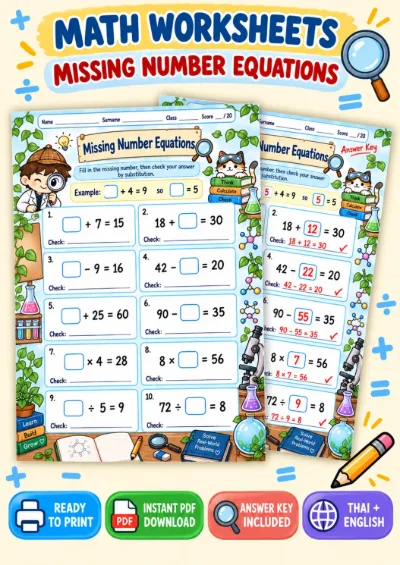
Grades 1–3 (P.1–P.3)
Missing Number Equations - Solve and Check
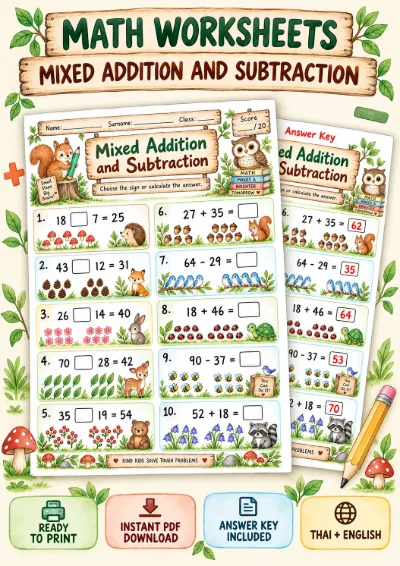
Grades 1–3 (P.1–P.3)
Mixed Addition and Subtraction - Choose the Sign
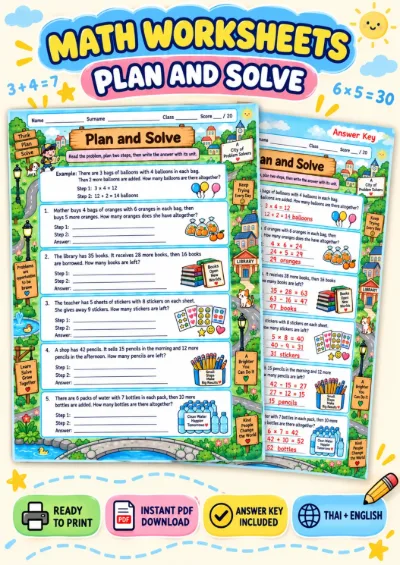
Grades 1–3 (P.1–P.3)
Multi-step Word Problems - Plan and Solve
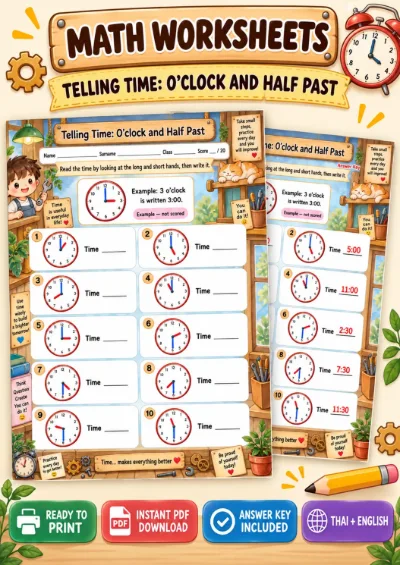
Grades 1–3 (P.1–P.3)
Telling Time: O'clock and Half Past - Read the Clock
Grades 1–3 (P.1–P.3)
Simple Comprehension - Read and Answer the Questions
Grades 4–6 (P.4–P.6)