

Grades 1–3 (P.1–P.3)
Word Detective Part 2 - Final Consonants Kong, Kon, Kom, Koei, Keo (Teaching Media)
29 Baht
View details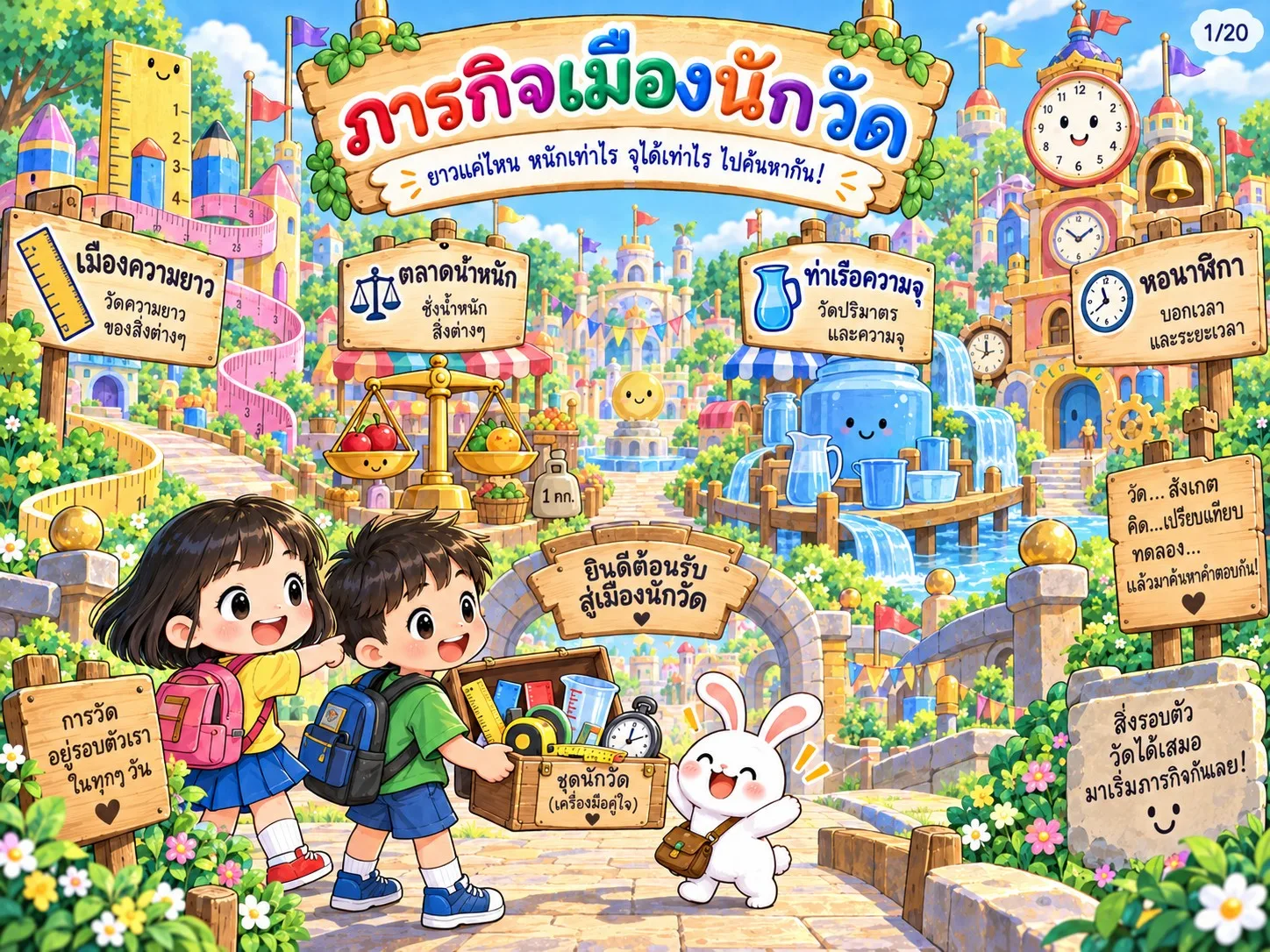
1 / 6
The preview is watermarked and lower resolution than the file you receive.
The preview is watermarked and lower resolution than the file you receive.
Mathematics Teaching Media worksheets on Measurement - Length, Weight, Capacity and Time for Grades 1–3 (P.1–P.3), difficulty 1/5. PDF, downloadable as soon…
Curriculum indicators practised
Before you begin
Compare and measure length, weight and capacity the right way (line up the ends, use equal-sized non-standard units, start the ruler at 0, look for the lower pan on a balance) and read o'clock times.
20 slides told as missions in four towns - Slides 2-5, Length Town: line up the pencil ends before comparing, order four ribbons, a pencil is 6 paper clips long and then measure a crayon, a rubber and a book, and a ruler shop that starts at 0 - Slides 6-10, Weight Market: guess apple or watermelon, the lower pan is heavier, three balances for heavier, lighter and equal, one box equals 4 weights so how many more are needed, sort the heaviest and lightest - Slides 11-14, Capacity Harbour: glass and jug, full, half and empty, 4 cups fill 1 jug, and a tall thin and a short wide container that hold the same - Slides 15-18, Clock Tower: the short hand shows the hour and the long hand the minutes, match 7, 10 and 4 o'clock to activities, order a four-picture routine, where the short hand points at 5 o'clock - Slides 19-20: a four-station review fair and a measuring badge - Many answers are spoken by the characters in speech bubbles
Use for a Year 1 measurement unit as four short lessons of 20-25 minutes, one per town, and slide 19 as an end-of-unit review. - Speech bubbles often state the answer, so ask the class first and read the bubble as the reveal; pair every town with a hands-on task such as measuring a pencil in paper clips or counting cups into a jug - On slide 14 actually pour the water before revealing, then follow up with the capacity and volume worksheet or the measuring length with a ruler worksheet
- Comparing lengths without lining up the ends (slide 2 insists on a common starting point) - Leaving gaps between paper clips or blocks so the count is off (slide 4) - Assuming the bigger object is heavier, or reading the balance backwards (slides 6-8 point to the lower pan) - Deciding the tall container holds more just because it is taller (slide 14) - Reading the long hand as the hour (slides 15 and 18)
A PDF written to the Thai curriculum. Buy this worksheet once and keep it; no monthly plan is required.
Download it as soon as payment clears. The link stays in your account, so you can fetch the file again whenever you need it.
Every worksheet is checked before it is published — the content, the artwork, the layout and the accuracy of the language. Download it and hand it out the same day. If printing it yourself is inconvenient, add printing and postage to the order.
By a teacher who works in Thai classrooms, for Grades 1 to 6.
Choose plain A4, heavier stock or photo paper, and we deliver it.
Grades 1–3 (P.1–P.3)

Grades 1–3 (P.1–P.3)

Grades 1–3 (P.1–P.3)

Grades 1–3 (P.1–P.3)