
Grades 1–3 (P.1–P.3)
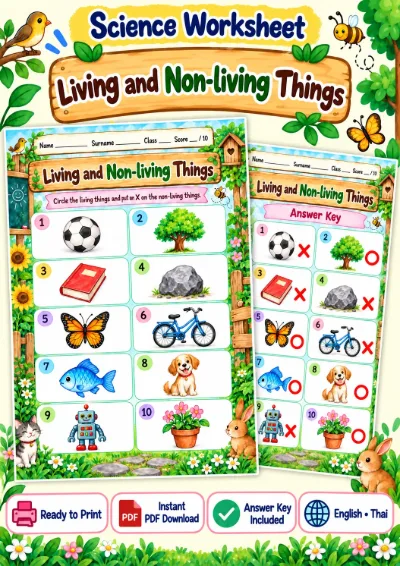
Living and Non-living Things - Circle and Cross
19 Baht
View detailsScience
An AR classroom game for Grade 3. Learners can aim with their hands at the camera or play by tapping the screen.
This set has 4 rounds in an interactive sorting activity.
Curriculum indicatorว 2.1 ป.4/1
A look before you play
A few real prompts from the game to help you choose an activity for your class.
Sort into
Metals conduct heat well; wood and plastic do not.
Sort into
Metals conduct electricity; rubber and glass are insulators.
Sort into
Some materials break down naturally; others take a very long time.
Before you play
Sorts materials by four properties: conducting heat, conducting electricity, breaking down, and absorbing water. Questions 1 and 2 match indicator ว 2.1 ป.4/1 (comparing hardness, elasticity, heat and electrical conduction), a Grade 4 topic; question 4 links to ว 2.1 ป.2/1 (absorbency).
4 questions, a sorting game with four items each - Copper and aluminium conduct heat well; wood and plastic do not - Copper wire and iron conduct electricity; rubber and glass are insulators - Fallen leaves and food scraps break down easily; a plastic bag and a glass bottle do not - Cotton cloth and tissue paper absorb water; a plastic bag and a tyre are waterproof
Use it after testing materials, such as dripping water on samples or standing different spoons in hot water, about 6 minutes in teams. After question 1, ask why pan handles are wood or plastic. Question 3 connects to the school's rubbish sorting. On question 2, stress safety: never experiment with mains electricity. You can link it to a class and record it in the gradebook. In English mode, the question 1 label does not conduct heat overstates it: wood and plastic conduct heat poorly, not at all, as the Thai label says.
- Question 3: saying the glass bottle breaks down easily because glass shatters. Separate them: shattering is not decomposing. - Question 2: calling glass a conductor because it is hard and shiny like metal. Point to the porcelain or glass insulators on power poles. - Question 4: calling the tyre absorbent because tyres are wet after rain. Ask whether the water soaks in or just sits on the surface.
Grades 1–3 (P.1–P.3)
Grades 1–3 (P.1–P.3)
Grades 1–3 (P.1–P.3)
Grades 1–3 (P.1–P.3)
 Sorting
ScienceGrade 14 rounds
 Matching
ScienceGrade 14 rounds
 Multiple choice
ScienceGrade 16 questions
 Multiple choice
ScienceGrade 16 questions