
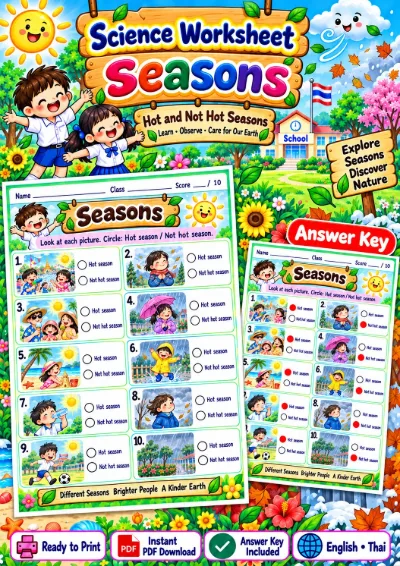
Grades 4–6 (P.4–P.6)
Seasons - Circle the Answer
19 Baht
View detailsScience
An AR classroom game for Grade 5. Learners can aim with their hands at the camera or play by tapping the screen.
This set has 4 rounds in an interactive ordering activity.
Curriculum indicatorว 3.1 ป.5/1
A look before you play
A few real prompts from the game to help you choose an activity for your class.
The first four are the rocky planets nearest the sun.
The outer four are the large gas planets.
The solar system sits inside a galaxy, which sits inside the universe.
Before you play
Orders the inner and outer planets by distance from the Sun, objects in space by size, and the steps that make day and night. Fits ว 3.1 ป.4/3 (the make-up of the solar system) and links to ว 3.1 ป.5/1 (comparing planets and stars).
4 questions, an ordering game with four pieces each - Mercury > Venus > Earth > Mars - Jupiter > Saturn > Uranus > Neptune - Moon > Earth > Sun > a galaxy - Earth turns on its axis > one side faces the Sun > that side has day > the other side has night
Use it after building a solar-system model with balls or pictures, about 5 minutes in teams. Before questions 1 and 2, have the class make up a Thai memory line for the eight planets. For question 3, compare with objects in the room, such as a bean and a ping-pong ball. On question 4, mention that the last two steps happen at the same time; the game orders them only for readability. You can link it to a class and record it in the gradebook.
- Question 2: swapping Uranus and Neptune, both distant and unfamiliar. Use the memory line. - Question 1: swapping Venus and Mars, knowing both are Earth's neighbours but not which side. - Question 4: swapping that side has day and the other side has night, which really happen together. Accept that the order is the game's choice.
Grades 4–6 (P.4–P.6)
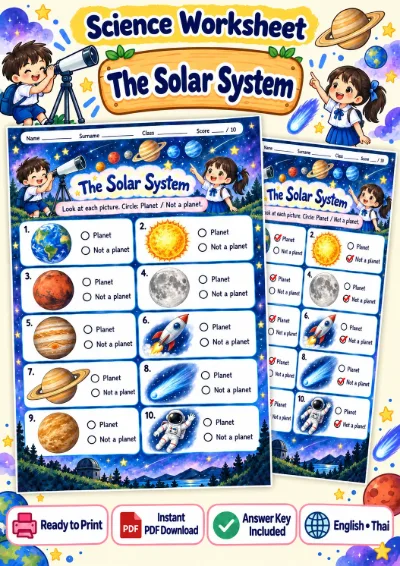
Grades 4–6 (P.4–P.6)
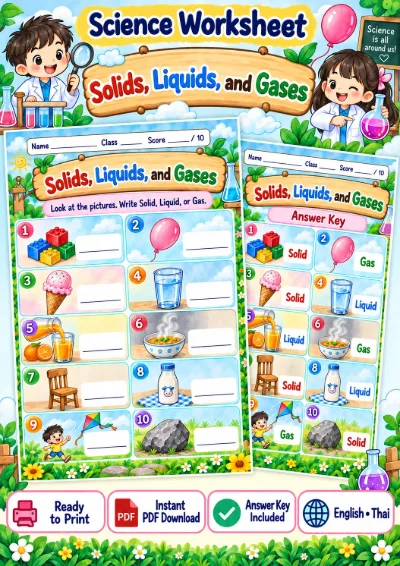
Grades 4–6 (P.4–P.6)
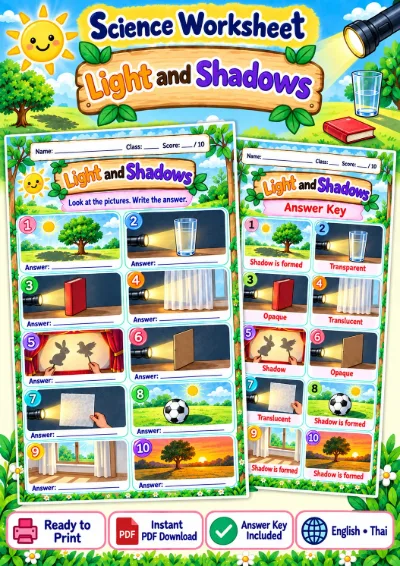
Grades 4–6 (P.4–P.6)
 Sorting
ScienceGrade 14 rounds
 Matching
ScienceGrade 14 rounds
 Multiple choice
ScienceGrade 16 questions
 Multiple choice
ScienceGrade 16 questions