
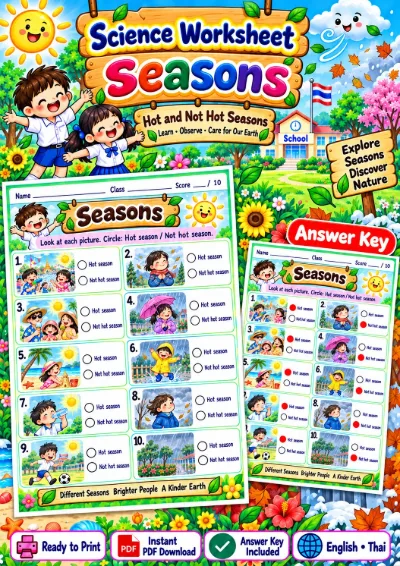
Grades 4–6 (P.4–P.6)
Seasons - Circle the Answer
19 Baht
View detailsScience
An AR classroom game for Grade 6. Learners can aim with their hands at the camera or play by tapping the screen.
This set has 4 rounds in an interactive matching activity.
Curriculum indicatorว 2.3 ป.6/2
A look before you play
A few real prompts from the game to help you choose an activity for your class.
Each device uses a different property of light.
A convex lens gathers light; a concave lens spreads it.
White light splits into seven colours, ordered by how much they bend.
Before you play
Matches devices to the light principle they use, lenses and mirrors to their uses, colours to how much they bend, and sight problems to their correction. It builds on ว 2.3 ป.2/1 and goes beyond Grade 6 on lenses; the tagged ว 2.3 ป.6/2 is about circuit diagrams.
4 questions, a matching game with four pairs each - Match a pinhole camera to light travelling in straight lines, and a prism to splitting white light - Match a convex mirror to a car wing mirror and a concave lens to glasses for short sight - Match red to bends least and violet to bends most - Match astigmatism to a cylindrical lens and long sight to a convex lens
Enrichment for a class that has already studied light, about 6-8 minutes in teams. Have a magnifying glass, a steel spoon (convex and concave sides) and a pinhole box ready for teams to try after each reveal. For question 4, ask who wears glasses and for what, on a voluntary basis. Warn children before question 4 that long sight and age-related long sight both use convex lenses. You can link it to a class and record it in the gradebook. Question 2 says lenses, but two of the four items are mirrors; tell children beforehand that it mixes lenses and mirrors.
- Question 4: swapping long sight and age-related long sight, since reading glasses are convex too. The two pairs really are interchangeable, so count a swap as correct. - Question 2: swapping convex and concave mirrors, unsure of นูน and เว้า. Look at your face in the back and the bowl of a spoon. - Question 3: swapping blue and violet because the colours are close. Recite the rainbow order.
Grades 4–6 (P.4–P.6)
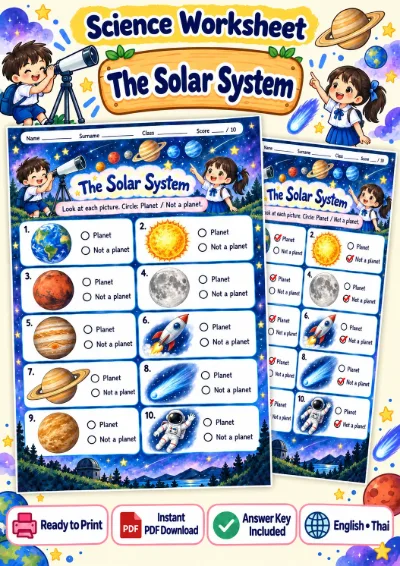
Grades 4–6 (P.4–P.6)
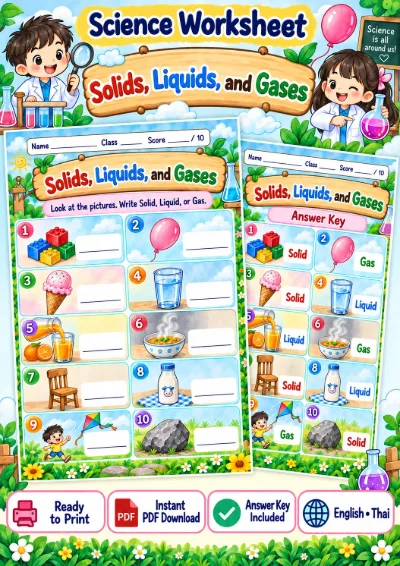
Grades 4–6 (P.4–P.6)
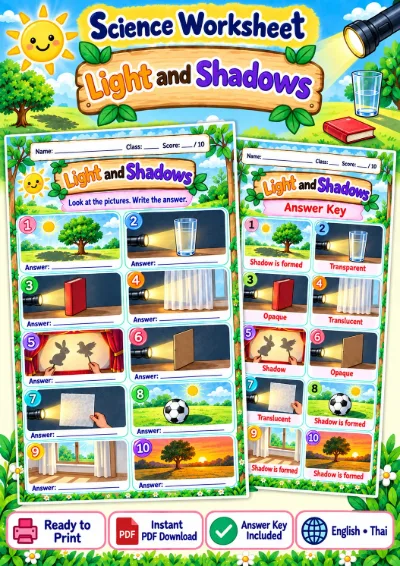
Grades 4–6 (P.4–P.6)
 Sorting
ScienceGrade 14 rounds
 Matching
ScienceGrade 14 rounds
 Multiple choice
ScienceGrade 16 questions
 Multiple choice
ScienceGrade 16 questions