
Grades 4–6 (P.4–P.6)
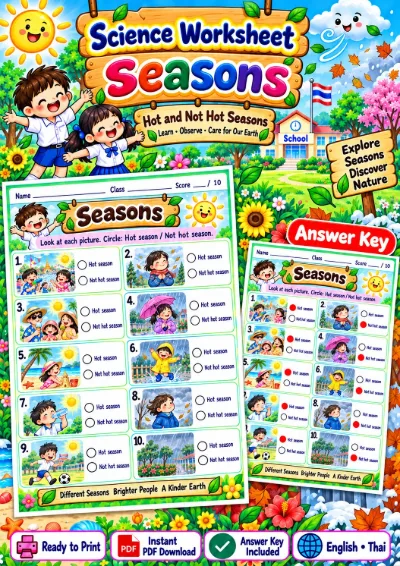
Seasons - Circle the Answer
19 Baht
View detailsScience
An AR classroom game for Grade 6. Learners can aim with their hands at the camera or play by tapping the screen.
This set has 6 questions in an interactive multiple choice activity.
A look before you play
A few real prompts from the game to help you choose an activity for your class.
Hair colour comes from your parents; skills come from practice.
A parallel circuit has several paths, so current still reaches the others.
A magnifying glass uses a convex lens, which gathers light and enlarges the image.
Before you play
A mixed Grade 6 review: an inherited trait, parallel circuits, the magnifying glass, marble, solar cells and the first step of engineering design. The six items are six different topics, so the set is not tied to any single indicator; use it as a general review.
6 questions, multiple choice with three options each - The inherited trait: hair colour (distractors swimming, speaking Chinese) - One bulb fails in a parallel circuit: the others stay lit - A magnifying glass uses a convex lens; marble is metamorphic - Solar cells turn light energy into electricity; engineering design starts by defining the problem
A 5-minute review before Grade 6 finals or O-NET, solo. Check the gradebook for the most-missed question and replay its topic set, such as QS-SCI-P6-ELEC-01 for question 2 or QS-SCI-P6-CAT-01 for question 4. Question 6 connects to design and technology lessons. You can link it to a class and record it in the gradebook.
- Question 4: choosing sedimentary, knowing marble comes from limestone, which is sedimentary. Explain that heat and pressure turn limestone into a metamorphic rock. - Question 2: choosing the others get much brighter, thinking the spare current goes to them. Build the circuit to show the brightness barely changes. - Question 3: choosing a concave lens, mixing it up with glasses for short sight.
Grades 4–6 (P.4–P.6)
Grades 4–6 (P.4–P.6)
Grades 4–6 (P.4–P.6)
Grades 4–6 (P.4–P.6)
 Sorting
ScienceGrade 14 rounds
 Matching
ScienceGrade 14 rounds
 Multiple choice
ScienceGrade 16 questions
 Multiple choice
ScienceGrade 16 questions