
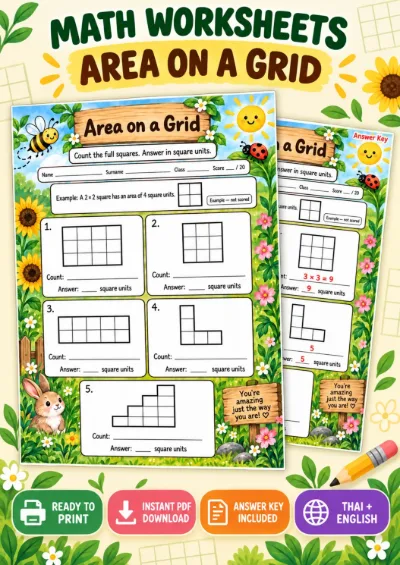
Grades 4–6 (P.4–P.6)
Area on a Grid - Count the Squares
19 Baht
View detailsMathematics
An AR classroom game for Grade 4. Learners can aim with their hands at the camera or play by tapping the screen.
This set has 6 questions in an interactive multiple choice activity.
Curriculum indicatorค 2.1 ป.4/3
A look before you play
A few real prompts from the game to help you choose an activity for your class.
Seven times four sides makes twenty-eight.
Five plus eight is thirteen, doubled is twenty-six.
Nine times nine makes eighty-one square units.
Before you play
Find the perimeter and area of rectangles and squares, work back from a perimeter to a side, and explain how area differs from perimeter (indicator ค 2.1 ป.4/3).
6 multiple-choice questions - A square with side 7 has perimeter 28; distractor 49 is its area - A 5 by 8 rectangle has perimeter 26; distractors 13 and 40 - A square with side 9 has area 81 - A 6 by 11 rectangle has area 66 - A square with perimeter 20 has sides of 5 - Perimeter measures the edge, area the inside
Use once both perimeter and area are taught, 7-8 minutes, team mode with squared paper. - Most distractors are the answer to the other measure, such as 49 in a perimeter question and 34 in an area question; after revealing, ask "Is this option an area or a perimeter?" - For Q6, teams trace the edge of a shape on squared paper with a finger, then shade the inside - If many choose 13 for the 5 by 8 rectangle, draw it and label all four sides - Play it linked to the class to record results in the mark book
- Choosing 13 for the 5 by 8 rectangle by adding only two sides, or 40 by finding the area. Label all four sides - Choosing 49 for the square with side 7, confusing area with perimeter - Choosing 10 for the side of a square with perimeter 20 by dividing by 2 instead of 4. Ask how many sides a square has
Grades 4–6 (P.4–P.6)
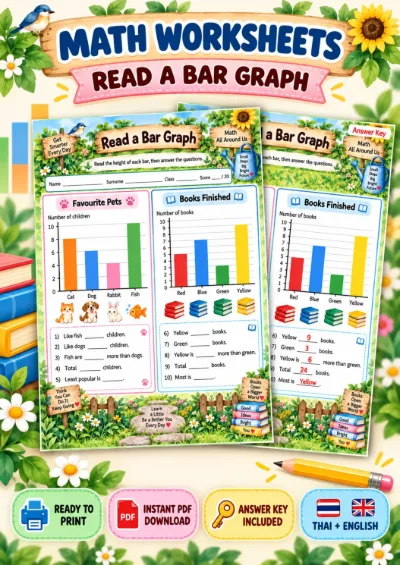
Grades 4–6 (P.4–P.6)
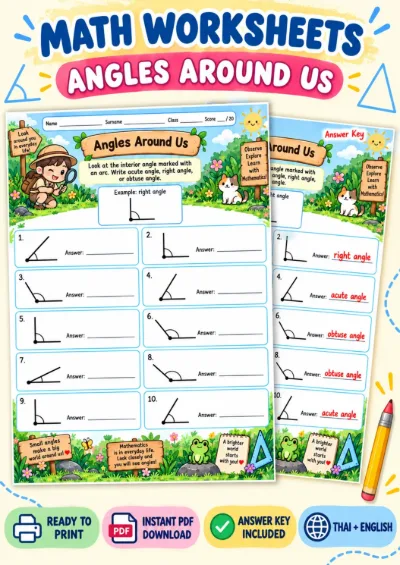
Grades 4–6 (P.4–P.6)
 Multiple choice
MathematicsGrade 16 questions
 Multiple choice
MathematicsGrade 16 questions
 Ordering
MathematicsGrade 14 rounds
 Sorting
MathematicsGrade 14 rounds