
Grades 4–6 (P.4–P.6)
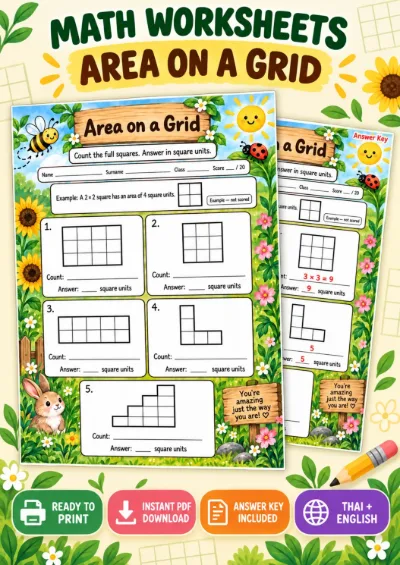
Area on a Grid - Count the Squares
19 Baht
View detailsMathematics
An AR classroom game for Grade 6. Learners can aim with their hands at the camera or play by tapping the screen.
This set has 4 rounds in an interactive sorting activity.
A look before you play
A few real prompts from the game to help you choose an activity for your class.
Sort into
Speed problems and area problems use different formulas.
Sort into
A rational number can be written as a fraction of whole numbers.
Sort into
Compare with one - a hundred per cent is exactly one whole.
Before you play
Choose the right method for a problem (speed or area formula), sort integers from non-integers, compare percentages and decimals with 1, and sort shapes with and without parallel sides.
4 sorting rounds, dragging 4 cards into 2 groups - Speed or area formula: how far a car goes in 3 hours, the area of a 4 by 5 room, how long a 100 km journey takes - Integer or not: -5, 0.5, 12, 3/4 - Less or more than 1: 50%, 150%, 0.75, 1.25 - Parallel sides or not: parallelogram, triangle, trapezium, circle
Use after speed and area, to practise reading which formula a problem needs; about 4-5 minutes. - Play as a class on the projector; in round 1 have children find key words such as hours, kilometres and area - In round 3, stress that 100% equals 1, then compare 150% and 50% - If negatives have not been taught, explain before round 2 that -5 is a whole number below zero - Some items extend beyond primary indicators. Use them for discussion or preparation for Grade 7, not to judge attainment - Play it linked to the class to record results in the mark book.
- Round 3: 50% may go in the more-than-1 group because 50 is a big number - Round 2: -5 may be thought not to be an integer because of the minus sign - Round 1: the card about a car in 3 hours gives no speed, so children may hesitate over which formula it needs
Grades 4–6 (P.4–P.6)
Grades 4–6 (P.4–P.6)
Grades 4–6 (P.4–P.6)
 Multiple choice
MathematicsGrade 16 questions
 Multiple choice
MathematicsGrade 16 questions
 Ordering
MathematicsGrade 14 rounds
 Sorting
MathematicsGrade 14 rounds