
Grades 4–6 (P.4–P.6)
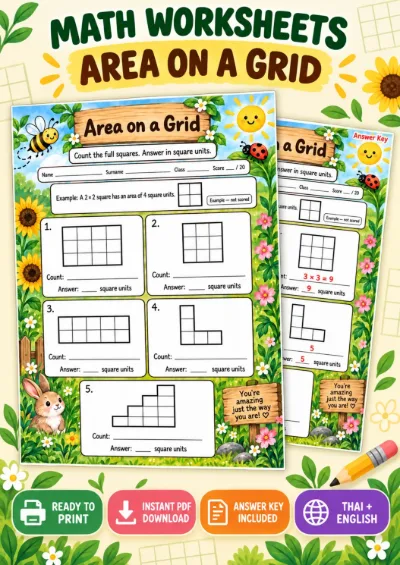
Area on a Grid - Count the Squares
19 Baht
View detailsMathematics
An AR classroom game for Grade 6. Learners can aim with their hands at the camera or play by tapping the screen.
This set has 4 rounds in an interactive matching activity.
Curriculum indicatorค 1.1 ป.6/9
A look before you play
A few real prompts from the game to help you choose an activity for your class.
Multiply the base by itself as many times as the exponent says.
Count the outcomes you want and divide by all the outcomes.
A square root is the number that times itself gives that number.
Before you play
Evaluate powers of 2 and 3, match dice and coin events to their probabilities, find square roots from 49 to 144, and match units to quantities.
4 matching rounds of 4 pairs each - Powers: 2^3 with 8, 3^2 with 9, 3^3 with 27 - Probability: rolling a 1 with 1/6, less than 3 with 1/3, less than 5 with 2/3 - Square roots: 121 with 11, 144 with 12 - Unit to quantity: degree with angle size, km/h with speed
Use as end-of-year enrichment for ready learners; about 5 minutes. - Play in teams, each with a real die for counting faces in round 2 - Explain the ^ symbol before round 1, since Thai textbooks write exponents as superscripts - In round 2, count the faces below 5 (1, 2, 3, 4), write 4/6 and simplify to 2/3 - Play it linked to the class to record results in the mark book.
- Round 1: 2^3 and 3^2 get swapped because they use the same digits - Round 2: 'less than 3' may be counted including 3, then paired with the coin's 1/2 - Round 2: 'less than 5' gives 4/6, which cannot be found until simplified to 2/3
Grades 4–6 (P.4–P.6)
Grades 4–6 (P.4–P.6)
Grades 4–6 (P.4–P.6)
 Multiple choice
MathematicsGrade 16 questions
 Multiple choice
MathematicsGrade 16 questions
 Ordering
MathematicsGrade 14 rounds
 Sorting
MathematicsGrade 14 rounds