
Grades 4–6 (P.4–P.6)
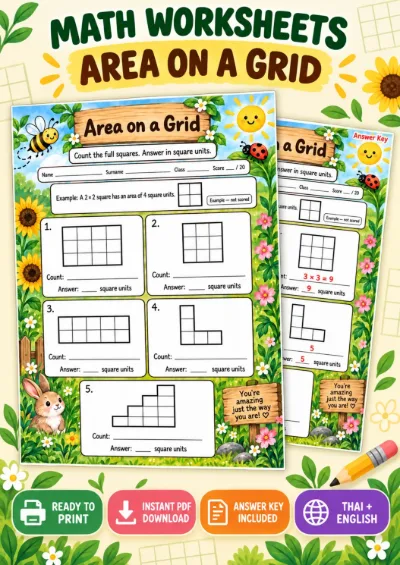
Area on a Grid - Count the Squares
19 Baht
View detailsMathematics
An AR classroom game for Grade 6. Learners can aim with their hands at the camera or play by tapping the screen.
This set has 4 rounds in an interactive ordering activity.
Curriculum indicatorค 1.2 ป.6/1
A look before you play
A few real prompts from the game to help you choose an activity for your class.
One, eight, twenty-seven and sixty-four are one to four cubed.
Seven, fourteen, twenty-one and twenty-eight are the seven times table.
Each number is the sum of the two before it.
Before you play
Spot number patterns (cube numbers, the 7 times table, the Fibonacci sequence) and put the steps for finding a sequence's rule in order, following ค 1.2 ป.6/1.
4 ordering rounds of 4 cards - Cube numbers smallest first: 1, 8, 27, 64 - Going up in 7s: 7, 14, 21, 28 - Fibonacci order: 1, 2, 3, 5 - Steps to find a rule: look at the numbers, find the differences, state the rule, use it for the next number
Use to open the patterns and relationships unit; about 4 minutes. - Play as a class on the projector; after round 3 ask for the next number after 1, 2, 3, 5 (it is 8) - For round 1, build a 2 × 2 × 2 cube to show why 8 is a cube number - Use round 4 as the routine for pattern problems throughout the unit - Play it linked to the class to record results in the mark book.
- Rounds 1-3 are simply ascending numbers, so children can order them without knowing cubes or Fibonacci; ask follow-up questions to check real understanding - Round 4: 'state the rule' and 'find the differences' may be swapped by children who guess the rule first - Round 3: children may ask why there is only one 1, having seen 1, 1, 2, 3, 5 elsewhere
Grades 4–6 (P.4–P.6)
Grades 4–6 (P.4–P.6)
Grades 4–6 (P.4–P.6)
 Multiple choice
MathematicsGrade 16 questions
 Multiple choice
MathematicsGrade 16 questions
 Ordering
MathematicsGrade 14 rounds
 Sorting
MathematicsGrade 14 rounds