
Grades 1–3 (P.1–P.3)
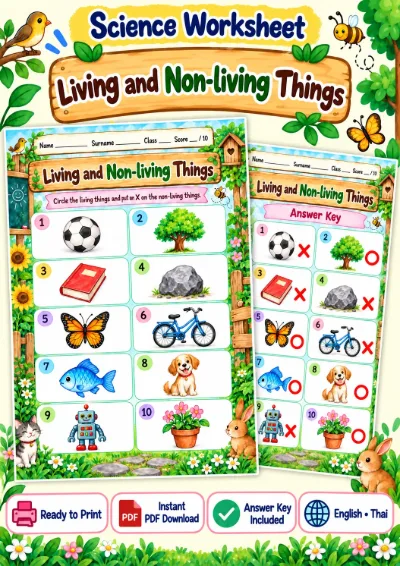
Living and Non-living Things - Circle and Cross
19 Baht
View detailsScience
An AR classroom game for Grade 1. Learners can aim with their hands at the camera or play by tapping the screen.
This set has 6 questions in an interactive multiple choice activity.
Curriculum indicatorว 2.3 ป.2/1
A look before you play
A few real prompts from the game to help you choose an activity for your class.
The sun is the natural light source that lights the whole earth.
A shadow appears when something opaque blocks the path of light.
Eyes need light to see; with none at all we see nothing.
Before you play
Early ideas about light and shadow: the Sun as a light source, shadows form when an object blocks light, we need light to see, shadows are longest morning and evening, opaque objects give the sharpest shadow, and night comes as the Earth turns. It matches indicator ว 2.3 ป.2/1 (how light travels and how we see), a Grade 2 topic; question 6, on day and night, is Grade 3 content.
6 questions, multiple choice with three options each - The largest natural light source is the Sun - A shadow forms when something blocks the light - Shadows are longest in the early morning and evening - An opaque object casts the sharpest shadow; night comes as the Earth turns away from the Sun
Play it after shadow play with a torch, or after looking at their own shadows in the sun, about 5-6 minutes. Read the questions aloud and play in teams. For question 4, if you can, measure children's shadows in the morning and at noon and compare. The words in question 5 (opaque, translucent, transparent) are hard for Grade 1, so hold up one real object of each kind first. You can link it to a class and record it in the gradebook.
- Question 4: choosing noon because strong sun should mean a big shadow. Let them see that noon gives the shortest shadow. - Question 2: choosing when there is no light at all, thinking a shadow is darkness. Switch off all the lights and ask whether they can still see a shadow. - Question 6: choosing the Sun sinks under the sea, from sunset pictures. Demonstrate the turning Earth with a globe and a torch.
Grades 1–3 (P.1–P.3)
Grades 1–3 (P.1–P.3)
Grades 1–3 (P.1–P.3)
Grades 1–3 (P.1–P.3)
 Sorting
ScienceGrade 14 rounds
 Matching
ScienceGrade 14 rounds
 Multiple choice
ScienceGrade 16 questions
 Multiple choice
ScienceGrade 16 questions