
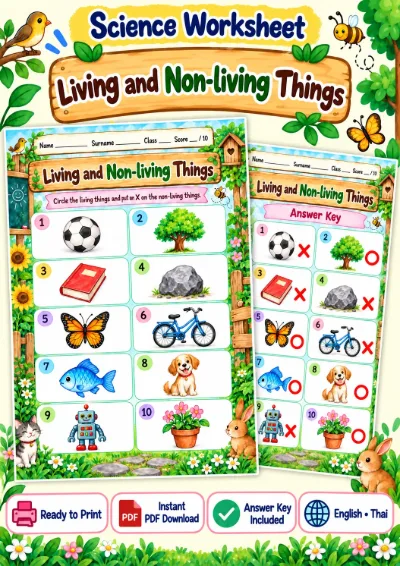
Grades 1–3 (P.1–P.3)
Living and Non-living Things - Circle and Cross
19 Baht
View detailsScience
An AR classroom game for Grade 2. Learners can aim with their hands at the camera or play by tapping the screen.
This set has 4 rounds in an interactive ordering activity.
Curriculum indicatorว 1.2 ป.3/3
A look before you play
A few real prompts from the game to help you choose an activity for your class.
Frogs lay eggs in water; tadpoles breathe through gills before coming onto land.
A hen lays an egg, it hatches into a chick, and the chick grows into a hen.
Many insects pass through a pupa stage before becoming adults.
Before you play
Orders the life cycles of a frog, a chicken, a fly and a bean. It matches indicator ว 1.2 ป.3/3 (modelling and comparing animal life cycles); question 4, the bean, links to ว 1.2 ป.2/3 (flowering plant life cycle).
4 questions, an ordering game with four stages each - Frog: egg > tadpole > tadpole with legs > adult frog - Chicken: egg > chick > young chicken > adult chicken - Fly: egg > larva > pupa > adult - Bean: seed > seedling > grown plant > pods form
Use it after a clip or pictures of life cycles and before children draw their own cycle, about 5 minutes in teams. Afterwards, compare which animals change shape a lot (frog, fly) and which simply grow (chicken). Children may find the fly unpleasant: connect it to covering rubbish bins to break the cycle. You can link it to a class and record it in the gradebook. In English mode, question 3 labels the fly's ดักแด้ as chrysalis, a butterfly word; for a fly it is a pupa. For question 4, add that the pods hold new seeds, so the cycle loops back to the start.
- Question 1: swapping tadpole and tadpole with legs, never having seen the legs appear. Show pictures of all four stages first. - Question 3: swapping larva and pupa, not knowing flies have a larva. Explain that the maggots in rubbish are young flies. - Question 2: swapping chick and young chicken because ไก่รุ่น is an unfamiliar word.
Grades 1–3 (P.1–P.3)
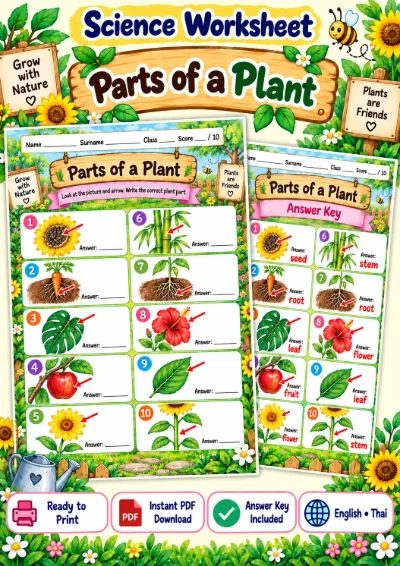
Grades 1–3 (P.1–P.3)
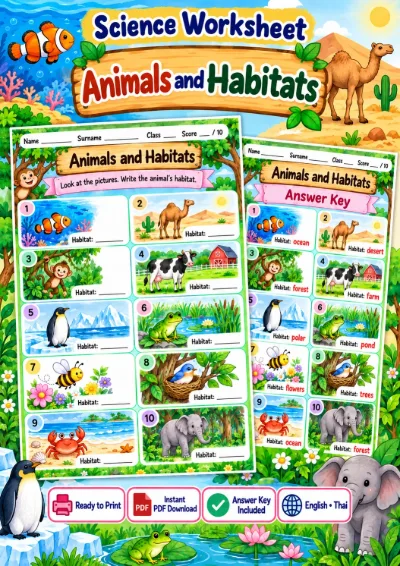
Grades 1–3 (P.1–P.3)
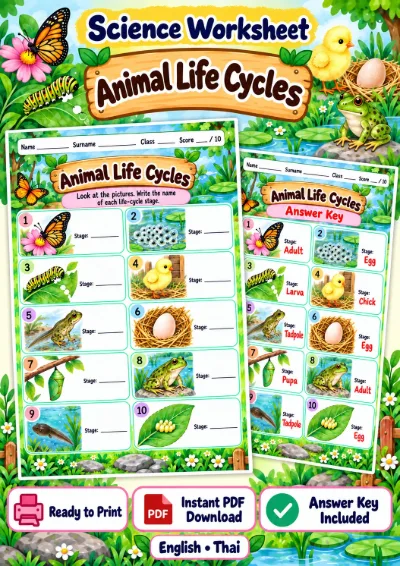
Grades 1–3 (P.1–P.3)
 Sorting
ScienceGrade 14 rounds
 Matching
ScienceGrade 14 rounds
 Multiple choice
ScienceGrade 16 questions
 Multiple choice
ScienceGrade 16 questions