
Grades 1–3 (P.1–P.3)
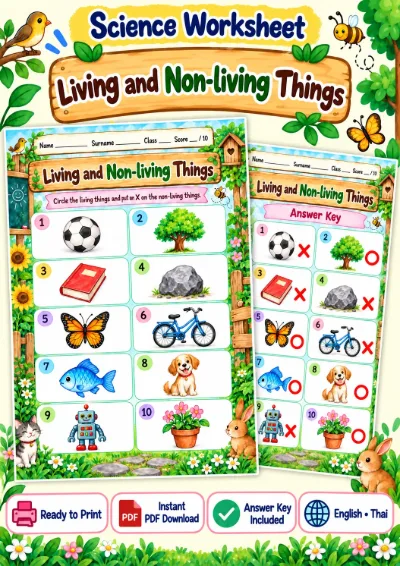
Living and Non-living Things - Circle and Cross
19 Baht
View detailsScience
An AR classroom game for Grade 2. Learners can aim with their hands at the camera or play by tapping the screen.
This set has 4 rounds in an interactive sorting activity.
Curriculum indicatorว 3.2 ป.2/1
A look before you play
A few real prompts from the game to help you choose an activity for your class.
Sort into
Soil comes from weathered rock mixed with dead plants and animals.
Sort into
Clay has fine grains and holds water well; sand has coarse grains and water runs straight through.
Sort into
Some resources run out when used; others replace themselves.
Before you play
Tells soil from rock, sorts soils by how they hold water, separates resources that run out from those that renew, and natural from built water sources. Matches ว 3.2 ป.2/1 (soil make-up and kinds of soil) and ป.2/2 (uses of soil).
4 questions, a sorting game with four items each - Loam and clay are soil; granite and limestone are rock - Clay and loam hold water well; sandy soil and gravel let water drain straight through - Oil and coal run out; sunlight and wind renew themselves - Rivers and the sea are natural; a dam and an irrigation canal are built by people
Play it after children have handled three soils and poured water through them in cut bottles, about 6 minutes in teams. In question 2, recall the real results before tapping. Questions 3 and 4 move a little beyond soil, so use them as a bridge to natural resources, for instance by asking the name of the nearest dam. You can link it to a class and record it in the gradebook.
- Question 1: calling clay a rock, having seen dried clay set hard. Let children feel wet clay next to a real rock. - Question 2: hesitating over loam, which holds water only moderately. Explain that compared with sand and gravel, loam holds water well. - Question 3: calling oil renewable because the petrol station never runs out. Explain that oil takes so long to form that it counts as running out. - Question 2: the prompt says sort the soils, but gravel is not a soil. If a child points this out, praise them, and explain that gravel is there to compare how fast water drains through.
Grades 1–3 (P.1–P.3)
Grades 1–3 (P.1–P.3)
Grades 1–3 (P.1–P.3)
Grades 1–3 (P.1–P.3)
 Sorting
ScienceGrade 14 rounds
 Matching
ScienceGrade 14 rounds
 Multiple choice
ScienceGrade 16 questions
 Multiple choice
ScienceGrade 16 questions