
Grades 1–3 (P.1–P.3)
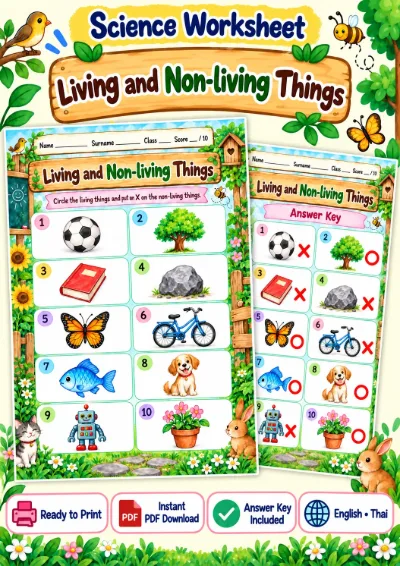
Living and Non-living Things - Circle and Cross
19 Baht
View detailsScience
An AR classroom game for Grade 2. Learners can aim with their hands at the camera or play by tapping the screen.
This set has 6 questions in an interactive multiple choice activity.
Curriculum indicatorว 2.3 ป.1/1
A look before you play
A few real prompts from the game to help you choose an activity for your class.
Sound comes from something vibrating, and travels through the air to the ear.
Sound travels through air, water and solids, but not through a vacuum.
Loudness depends on how big the vibration is - a stronger vibration is louder.
Before you play
About sound: it comes from vibration, travels through air, water and solids, loudness depends on how big the vibration is, pitch on how fast it vibrates, protecting your ears, and why space is silent. Question 1 matches indicator ว 2.3 ป.1/1 (how sound is made and travels); questions 2-6 are Grade 5 content (ว 2.3 ป.5/1-5/5), best treated as enrichment.
6 questions, multiple choice with three options each - Sound comes from an object vibrating - Sound travels through air, water and solids - Loud or quiet depends on the size of the vibration; high or low on how fast it vibrates - Space is silent because there is no air for sound to travel through
Play it after making cup telephones or plucking rubber bands, about 5-6 minutes in teams. One rubber band demonstrates both questions 3 and 4: pluck hard and soft for loudness, stretch it tighter or looser for pitch. For question 2, have a child press an ear to the desk while a friend taps gently at the far end. You can link it to a class and record it in the gradebook. Question 4 uses ความถี่ (frequency), a hard word for Grade 2; explain it simply as vibrating fast or slow.
- Questions 3 and 4: swapping size of vibration and how fast it vibrates, since both ideas are new and sound alike. Demonstrate each separately with a rubber band. - Question 2: choosing only air, never having listened underwater. Try the ear-to-desk test. - Question 6: choosing no gravity, linking space with floating. Stress that sound needs something to travel through.
Grades 1–3 (P.1–P.3)
Grades 1–3 (P.1–P.3)
Grades 1–3 (P.1–P.3)
Grades 1–3 (P.1–P.3)
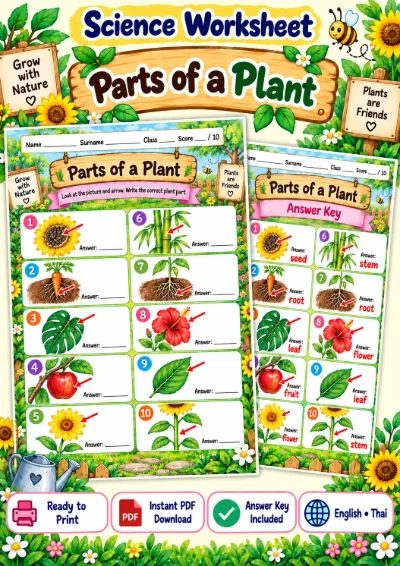
 Sorting
ScienceGrade 14 rounds
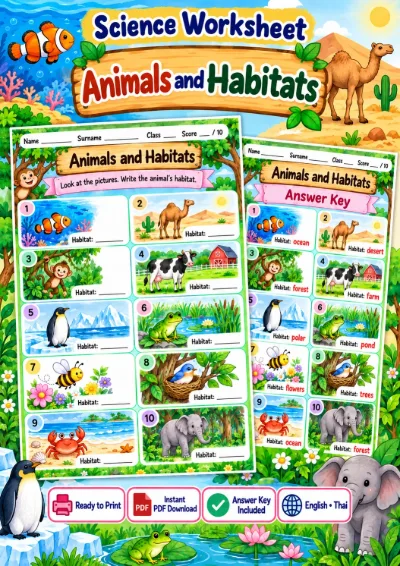
 Matching
ScienceGrade 14 rounds
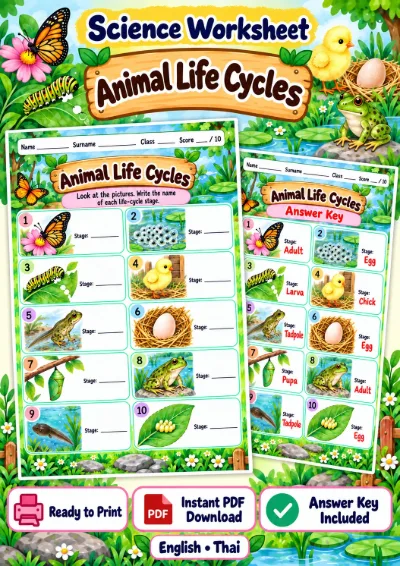
 Multiple choice
ScienceGrade 16 questions
 Multiple choice
ScienceGrade 16 questions