
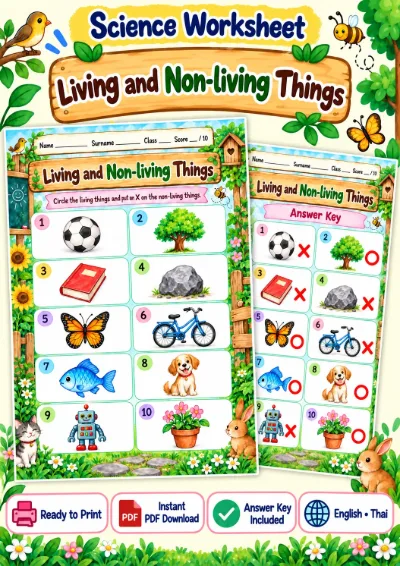
Grades 1–3 (P.1–P.3)
Living and Non-living Things - Circle and Cross
19 Baht
View detailsScience
An AR classroom game for Grade 3. Learners can aim with their hands at the camera or play by tapping the screen.
This set has 6 questions in an interactive multiple choice activity.
Curriculum indicatorว 2.3 ป.2/1
A look before you play
A few real prompts from the game to help you choose an activity for your class.
Light falls on the object and bounces back into our eyes.
A smooth shiny surface like a mirror reflects light best.
Light travels in straight lines through one medium.
Before you play
Light and seeing: we see because light reflects into our eyes, mirrors reflect well, light travels in straight lines, refraction, the bent-looking spoon, and rainbows. Questions 1-3 match indicator ว 2.3 ป.2/1 (how light travels and how we see); questions 4-6, on refraction and rainbows, go beyond the primary indicators and work as enrichment.
6 questions, multiple choice with three options each - We see because light reflects off objects into our eyes (distractor: our eyes send light out) - A mirror reflects best; light travels in straight lines - A spoon in water looks bent because light refracts at the surface - A rainbow forms when water droplets split white light into colours
Play it after a dark-room light activity such as shining a torch through a row of holes in card, about 6 minutes in teams. After question 5, give each team a clear glass of water and a pencil to look for themselves. For question 6, on a sunny day, spray a fine mist with your back to the sun to make a real rainbow. ตัวกลาง (medium) in question 4 is hard for Grade 3: explain it as what the light passes through, like air or water. You can link it to a class and record it in the gradebook.
- Question 1: choosing our eyes send light out, a belief children often hold. Ask: if eyes gave out light, why can't we see in a dark room? - Question 5: choosing the water bends the spoon because it really looks bent. Lift the spoon out and show it is still straight. - Question 4: confusing refraction with reflection, both new words. Separate them: reflection bounces back, refraction passes through but turns.
Grades 1–3 (P.1–P.3)
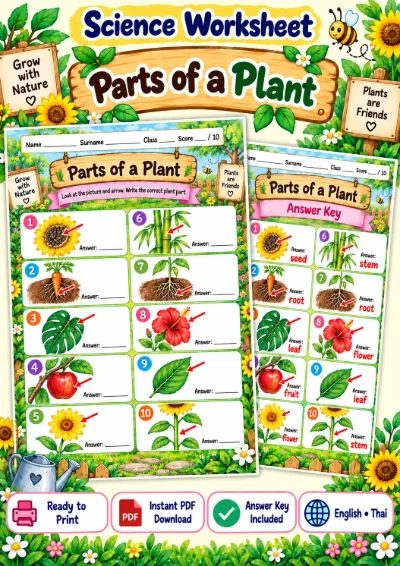
Grades 1–3 (P.1–P.3)
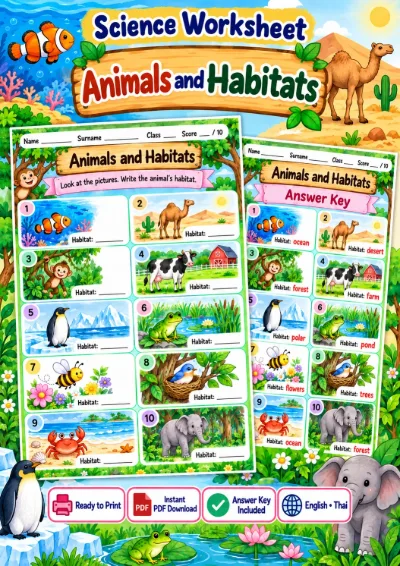
Grades 1–3 (P.1–P.3)
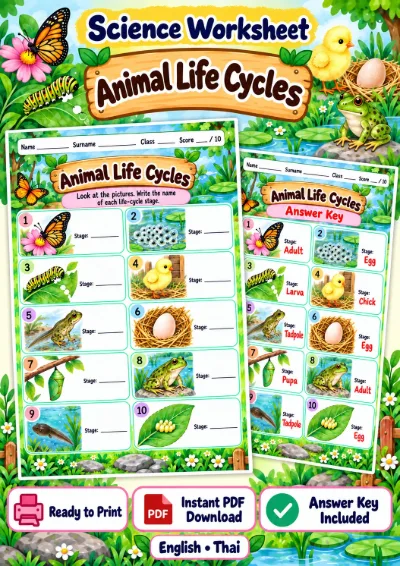
Grades 1–3 (P.1–P.3)
 Sorting
ScienceGrade 14 rounds
 Matching
ScienceGrade 14 rounds
 Multiple choice
ScienceGrade 16 questions
 Multiple choice
ScienceGrade 16 questions