

Grades 1–3 (P.1–P.3)
Word Detective Part 2 - Final Consonants Kong, Kon, Kom, Koei, Keo (Teaching Media)
29 Baht
View details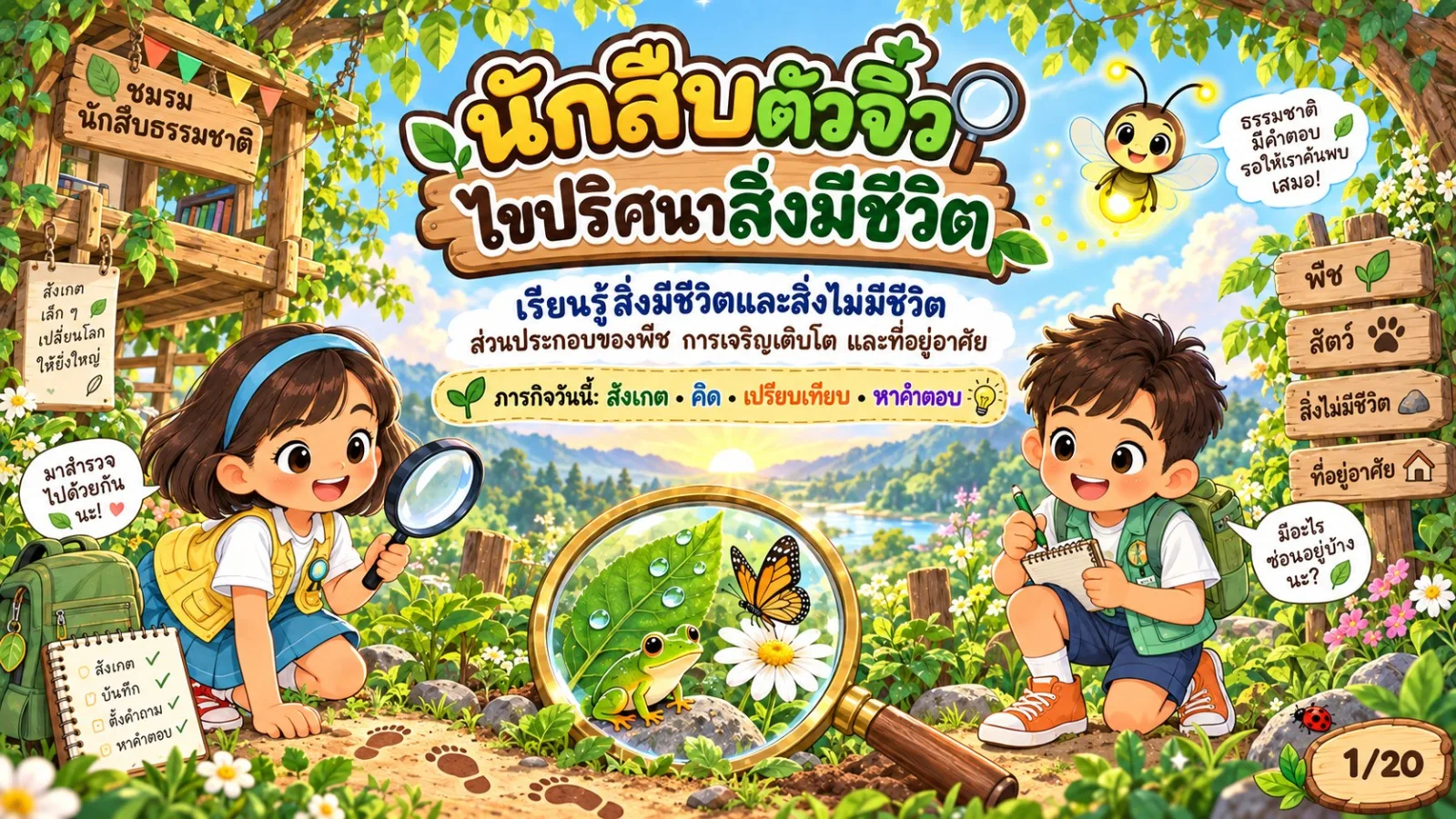
1 / 6
The preview is watermarked and lower resolution than the file you receive.
The preview is watermarked and lower resolution than the file you receive.
Science Teaching Media worksheets on Living and Non-living Things for Grades 1–3 (P.1–P.3), difficulty 1/5. PDF, downloadable as soon as payment clears.
Curriculum indicators practised
Before you begin
Tell living from non-living things using evidence (moving, needing water and food, growing, responding), know what roots, stems, leaves, flowers and fruit do, learn that plants need sunlight, water, air and soil, order growth from seed to flower, and match animals to their habitats.
20 slides (follow the page number in the bottom-right corner); two young detectives and a firefly explore - Pages 2-3: living things (grow, need food and water, breathe and reproduce) versus non-living things (chair, rock, ball, kite), four pieces of evidence, and the question: a tree cannot walk, so is it alive, and why? - Pages 4-9, plants: what roots, stems, leaves, flowers and fruit do; plants need sunlight, water, air, and soil with nutrients; how water travels from root to leaf (what happens to leaves without water?); seed, sprout, seedling, grown plant, flowering; a bean on days 1, 3, 5 and 7; and flower to fruit to seed - Pages 10-14, habitats: pond, dry land, forest and flower garden; clues to who lives here (duck footprints, a feather, a nibbled leaf, a burrow); and what a bird, frog, rabbit and flowering plant need at home - Pages 15-20, review: pick what plants really need (not sweets, a robot, a ball or a chair), point to plant parts, a summary, a four-question review game, a five-question final mission and a certificate - No separate answer slides, but pages 18-19 already show the answers
Use to open a Year 1 living-things unit over two or three lessons of about 30-40 minutes (pages 1-9 living things and plants, 10-20 habitats and review). - Pause on page 3 and let children argue whether a tree is alive, using the four pieces of evidence; start growing beans in cups alongside page 8 so children record real days 1, 3, 5 and 7 - After the unit, check understanding with the living and non-living things worksheet and the parts of a plant worksheet
- Thinking anything that moves is alive, such as a kite, a car or flowing water, and that plants are not alive because they cannot walk (page 3 asks this directly) - Believing plants get their food from the soil, not realising leaves make food (pages 4 and 6) - Mixing up the order of growth, or thinking fruit comes before the flower (pages 7 and 9) - Placing an animal in the wrong habitat because they have seen it somewhere else, e.g. thinking frogs live only in forests
A PDF written to the Thai curriculum. Buy this worksheet once and keep it; no monthly plan is required.
Download it as soon as payment clears. The link stays in your account, so you can fetch the file again whenever you need it.
Every worksheet is checked before it is published — the content, the artwork, the layout and the accuracy of the language. Download it and hand it out the same day. If printing it yourself is inconvenient, add printing and postage to the order.
By a teacher who works in Thai classrooms, for Grades 1 to 6.
Choose plain A4, heavier stock or photo paper, and we deliver it.
Grades 1–3 (P.1–P.3)

Grades 1–3 (P.1–P.3)

Grades 1–3 (P.1–P.3)

Grades 1–3 (P.1–P.3)