

Grades 1–3 (P.1–P.3)
Word Detective Part 2 - Final Consonants Kong, Kon, Kom, Koei, Keo (Teaching Media)
29 Baht
View details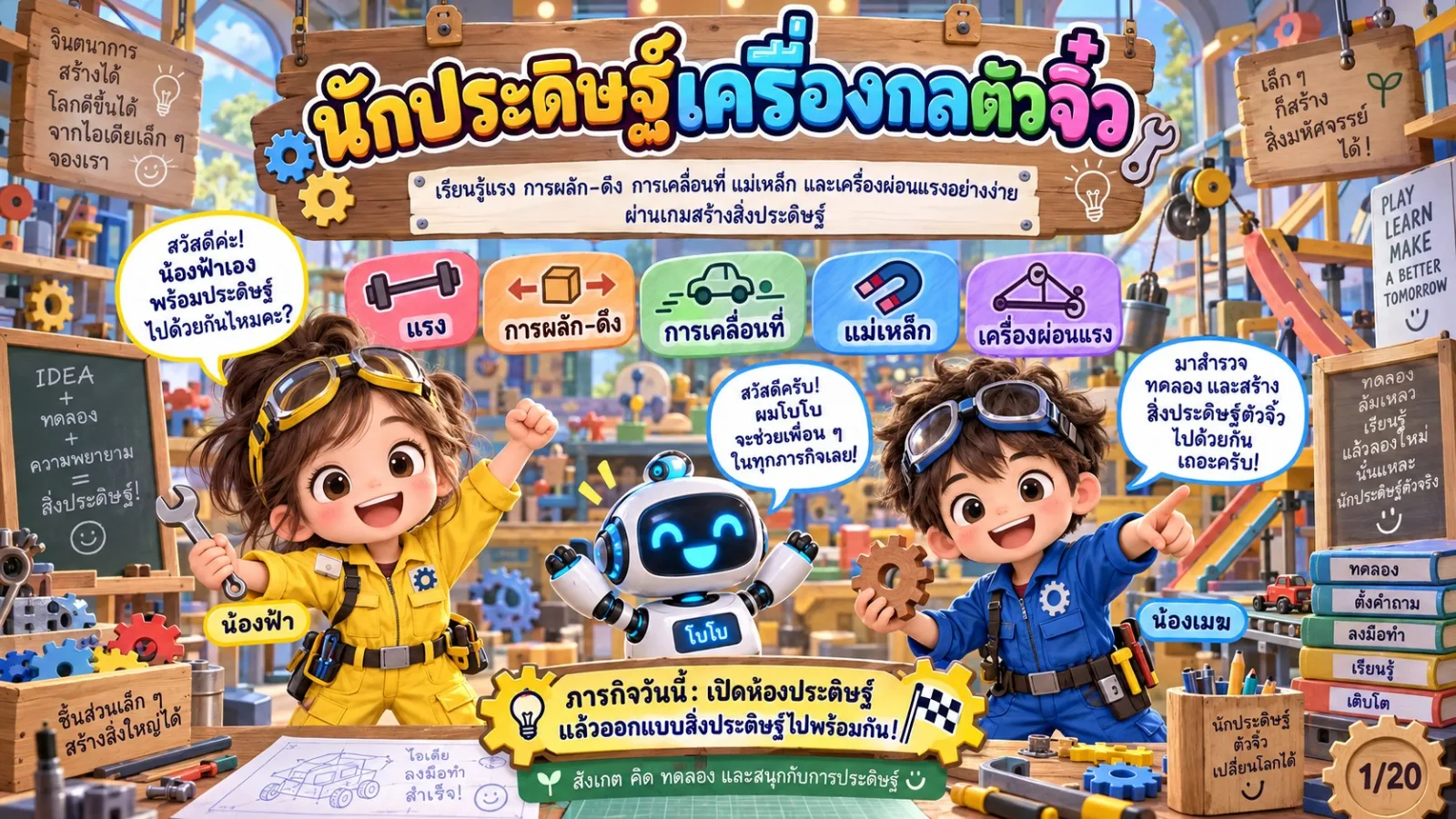
1 / 6
The preview is watermarked and lower resolution than the file you receive.
The preview is watermarked and lower resolution than the file you receive.
Science Teaching Media worksheets on Forces, Magnets and Simple Machines for Grades 1–3 (P.1–P.3), difficulty 1/5. PDF, downloadable as soon as payment clears.
Curriculum indicators practised
Before you begin
Learn that a force is a push or a pull, tell pushing (moving something away from you) from pulling (moving it towards you), describe motion as fast, slow, stopped and by direction, learn that magnets attract iron but not every material, and meet six simple machines found in everyday life: lever, wheel and axle, pulley, inclined plane, wedge and screw.
20 slides in an inventors' workshop with Fah, Mek and Bobo the robot - Slides 1-8, forces and motion: a force is a push or a pull (circle the pictures showing a force: pushing a trolley, pulling a rope, sleeping, reading); pushing (toy car, box, shopping trolley, door); pulling (wagon, drawer, rope, chair); sort eight pictures into push or pull; motion means changing position; fast, slow, stopped and moving; directions forwards, backwards, up, down, left and right - Slides 9-10, magnets: what they attract (paper clips, nails, screws) and what they do not (wood, plastic, glass, rubber, paper), with a hands-on sort into baskets - Slides 11-16, simple machines: an overview of six; the lever (effort, load, fulcrum; seesaw, bottle opener, crowbar, scissors); wheel and axle (bicycle, door knob, steering wheel); pulley (flagpole, well, curtains); inclined plane (loading ramp, slide); wedge and screw (knife, axe, screw, screw-top lid) - Slides 17-20: design an invention using two simple machines, match everyday objects to machines, a three-part review and a certificate - There are no answer slides
Use in a Year 2-3 forces and simple machines unit over three or four lessons of about 30-40 minutes (slides 1-8, 9-10, 11-16, 17-20). - On slide 10 let children test a magnet on real classroom items such as clips, spoons, keys and coins and record the results; some real results differ from the slides, so try them yourself first - On slides 12 and 15 demonstrate with real things, such as a ruler over a pencil as a lever to lift a pencil case and pushing a toy car up a ramp versus lifting it straight up, then set the forces and motion worksheet and the magnets worksheet
- Thinking magnets attract all metals, including aluminium and copper (slide 9 says only some metals) - Mixing up push and pull when the picture is unclear, such as a child dragging a box with a rope or a bulldozer pushing soil (slides 3 and 5) - Thinking simple machines must be big machinery, not realising scissors, door knobs and screw-top lids are simple machines - Thinking a still object such as a tree or a chair has no forces acting on it
A PDF written to the Thai curriculum. Buy this worksheet once and keep it; no monthly plan is required.
Download it as soon as payment clears. The link stays in your account, so you can fetch the file again whenever you need it.
Every worksheet is checked before it is published — the content, the artwork, the layout and the accuracy of the language. Download it and hand it out the same day. If printing it yourself is inconvenient, add printing and postage to the order.
By a teacher who works in Thai classrooms, for Grades 1 to 6.
Choose plain A4, heavier stock or photo paper, and we deliver it.
Grades 1–3 (P.1–P.3)

Grades 1–3 (P.1–P.3)

Grades 1–3 (P.1–P.3)

Grades 1–3 (P.1–P.3)